
Champagne Tower - Solution & Explanation
Problem Statement
We stack glasses in a pyramid, where the first row has 1 glass, the second row has 2 glasses, and so on until the 100th row. Each glass holds one cup of champagne.
Then, some champagne is poured into the first glass at the top. When the topmost glass is full, any excess liquid poured will fall equally to the glass immediately to the left and right of it. When those glasses become full, any excess champagne will fall equally to the left and right of those glasses, and so on. (A glass at the bottom row has its excess champagne fall on the floor.)
For example, after one cup of champagne is poured, the top most glass is full. After two cups of champagne are poured, the two glasses on the second row are half full. After three cups of champagne are poured, those two cups become full - there are 3 full glasses total now. After four cups of champagne are poured, the third row has the middle glass half full, and the two outside glasses are a quarter full, as pictured below.
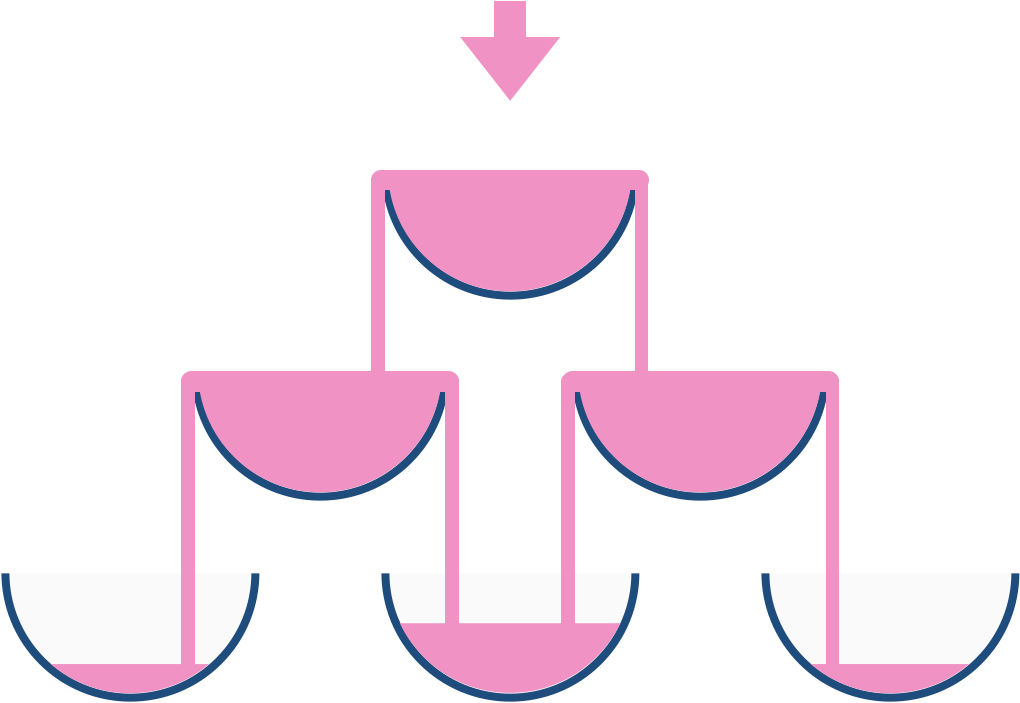
Now after pouring some non-negative integer cups of champagne, return how full the jth glass in the ith row is (both i and j are 0-indexed.)
Example 1:
Input: poured = 1, query_row = 1, query_glass = 1
Output: 0.00000
Explanation: We poured 1 cup of champange to the top glass of the tower (which is indexed as (0, 0)). There will be no excess liquid so all the glasses under the top glass will remain empty.
Example 2:
Input: poured = 2, query_row = 1, query_glass = 1
Output: 0.50000
Explanation: We poured 2 cups of champange to the top glass of the tower (which is indexed as (0, 0)). There is one cup of excess liquid. The glass indexed as (1, 0) and the glass indexed as (1, 1) will share the excess liquid equally, and each will get half cup of champange.
Example 3:
Input: poured = 100000009, query_row = 33, query_glass = 17
Output: 1.00000
Constraints:
0 <= poured <= 1090 <= query_glass <= query_row < 100
Approach Overview
Problem Overview: You pour poured cups of champagne into the top glass of a triangular tower. Each glass holds exactly 1 cup. Any overflow splits evenly to the two glasses below it. Given query_row and query_glass, compute how full that specific glass is after the champagne settles.
Approach 1: Simulation Using a Matrix (Time: O(n^2), Space: O(n^2))
The most direct way is to simulate the tower row by row using a 2D matrix. Create a matrix where tower[r][c] stores how much champagne reaches that glass. Start by placing poured in the top glass. Iterate through each row and check if a glass exceeds capacity (greater than 1). Any extra amount (value - 1) is split evenly and added to the two glasses below: (r+1, c) and (r+1, c+1). Continue propagating overflow until reaching query_row.
This approach mirrors the physical process of champagne flowing down the pyramid. The matrix ensures every overflow is tracked correctly. Because the tower up to row n contains roughly n^2/2 glasses, the simulation runs in O(n^2) time and uses O(n^2) space. This technique resembles classic dynamic programming where each state depends on the row above.
Approach 2: Space Optimized DP (Time: O(n^2), Space: O(n))
The observation: each row only depends on the previous row. Instead of storing the entire triangle, maintain a single array representing the current row. Start with an array where the first element equals poured. For every row, iterate from right to left and compute overflow contributions. If dp[i] > 1, the excess (dp[i] - 1) / 2 flows to dp[i] and dp[i+1] in the next iteration.
Processing from right to left prevents overwriting values needed for calculations. After processing query_row iterations, the target glass is simply min(1, dp[query_glass]). The logic still evaluates every glass up to the target row, so the time complexity remains O(n^2), but memory drops to O(n). This pattern is common in dynamic programming problems where transitions only depend on the previous layer of a triangular structure.
The state transition is straightforward: overflow from (r, c) contributes equally to (r+1, c) and (r+1, c+1). Because the tower structure resembles Pascal’s triangle, the DP flow is easy to reason about once you visualize the champagne distribution.
Recommended for interviews: Interviewers typically expect the dynamic programming simulation. Start with the matrix-based simulation to show you understand how overflow propagates through the tower. Then mention the space optimization that compresses rows into a single array. Demonstrating both versions shows strong reasoning about DP state transitions and memory optimization, which is common in problems involving triangular arrays or layered simulations.
Approach 1: Simulation Approach Using a Matrix
In this approach, we simulate the pouring process using a 2D array, where each element represents a glass and stores the amount of champagne in it. We iterate over each row, calculating the overflow and distributing it equally to the glasses directly below the current glass.
In this implementation, we use a 2D array 'tower' to track champagne levels in glasses. We initially pour all champagne into the top glass and simulate champagne overflow row by row.
Complexity
Time Complexity: O(n^2) where n is the number of rows traversed. Space Complexity: O(n^2) for the 2D array used to simulate the champagne distribution.
Approach 2: Space Optimized Approach
This approach optimizes the space complexity by using only a single array to store the champagne volumes, representing only two rows at a time.
Instead of using a 2D array, we use a single array to minimize space usage. This array tracks only the current row and is updated row-by-row in place, calculating overflows accordingly.
Complexity
Time Complexity: O(n^2). Space Complexity: O(n) due to the use of the single array.
Approach 3: Simulation
We directly simulate the process of pouring champagne.
Define a 2D array f, where f[i][j] represents the amount of champagne in the j-th glass of the i-th layer. Initially, f[0][0] = poured.
For each layer, if the amount of champagne in the current glass f[i][j] is greater than 1, the champagne will flow to two glasses in the next layer. The amount flowing in is \frac{f[i][j]-1}{2}, which is the amount of champagne in the current glass minus 1 and then divided by 2. Then the amount of champagne in the current glass is updated to 1.
After the simulation ends, return f[query_row][query_glass].
The time complexity is O(n^2), and the space complexity is O(n^2), where n is the number of layers, i.e., query_row.
Approach 4: Simulation (Space Optimization)
Since the amount of champagne in each layer only depends on the amount in the previous layer, we can use a rolling array approach to optimize space complexity, converting the 2D array to a 1D array.
The time complexity is O(n^2), and the space complexity is O(n), where n is the number of layers, i.e., query_row.
Complexity Comparison
| Approach | Complexity |
|---|---|
| Simulation Approach Using a Matrix | Time Complexity: O(n^2) where n is the number of rows traversed. Space Complexity: O(n^2) for the 2D array used to simulate the champagne distribution. |
| Space Optimized Approach | Time Complexity: O(n^2). Space Complexity: O(n) due to the use of the single array. |
| Simulation | — |
| Simulation (Space Optimization) | — |
Detailed Complexity Analysis
| Approach | Time | Space | When to Use |
|---|---|---|---|
| Simulation Using a Matrix | O(n^2) | O(n^2) | Best for understanding the overflow process clearly and visualizing the entire tower |
| Space Optimized Dynamic Programming | O(n^2) | O(n) | Preferred when memory usage matters or when implementing a concise interview solution |
Video Solution
Champagne Tower - Leetcode 799 - Python • NeetCodeIO • 17,215 views views
Watch 9 more video solutions →Frequently Asked Questions
Is Champagne Tower easy or hard?
How to solve Champagne Tower in O(n)?
What is the best approach for Champagne Tower?
What data structure is used in Champagne Tower?
What is the time complexity of Champagne Tower?
Champagne Tower Python or Java solution approach?
Is Champagne Tower asked at Google, Amazon, or Meta?
Ready to solve this problem?
Practice Champagne Tower with our built-in code editor and test cases.
Practice on FleetCode