
All Paths from Source Lead to Destination - Solution & Explanation
Problem Statement
Given the edges of a directed graph where edges[i] = [ai, bi] indicates there is an edge between nodes ai and bi, and two nodes source and destination of this graph, determine whether or not all paths starting from source eventually, end at destination, that is:
- At least one path exists from the
sourcenode to thedestinationnode - If a path exists from the
sourcenode to a node with no outgoing edges, then that node is equal todestination. - The number of possible paths from
sourcetodestinationis a finite number.
Return true if and only if all roads from source lead to destination.
Example 1:
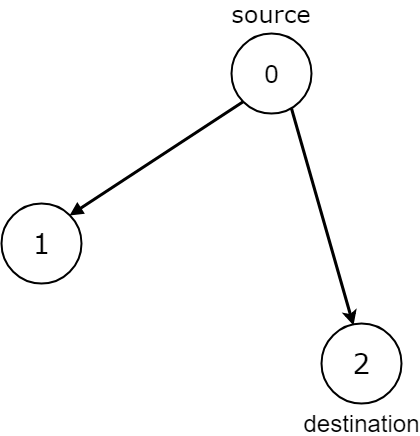
Input: n = 3, edges = [[0,1],[0,2]], source = 0, destination = 2
Output: false
Explanation: It is possible to reach and get stuck on both node 1 and node 2.
Example 2:
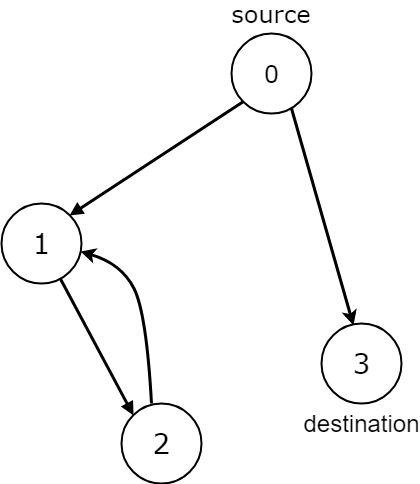
Input: n = 4, edges = [[0,1],[0,3],[1,2],[2,1]], source = 0, destination = 3
Output: false
Explanation: We have two possibilities: to end at node 3, or to loop over node 1 and node 2 indefinitely.
Example 3:
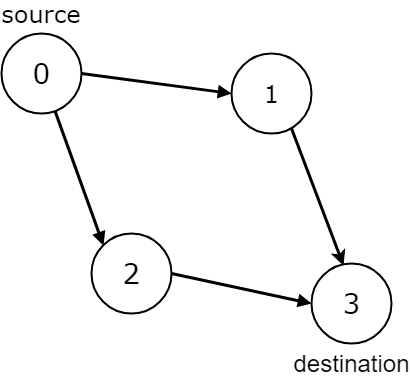
Input: n = 4, edges = [[0,1],[0,2],[1,3],[2,3]], source = 0, destination = 3
Output: true
Constraints:
1 <= n <= 1040 <= edges.length <= 104edges.length == 20 <= ai, bi <= n - 10 <= source <= n - 10 <= destination <= n - 1- The given graph may have self-loops and parallel edges.
Approach Overview
Problem Overview: Given a directed graph, a source node, and a destination node, verify that every possible path starting from the source eventually ends at the destination. No path should end at another node, and cycles that allow infinite traversal must not exist.
Approach 1: Brute Force DFS Path Exploration (Exponential time)
Start from the source and recursively explore every outgoing edge using depth‑first search. Track the current path and stop when you reach a node with no outgoing edges. If that terminal node is not the destination, the condition fails. This method effectively enumerates paths and checks each terminal state. Time complexity can grow exponentially in dense graphs because the same subgraphs are explored repeatedly. Space complexity is O(V) for the recursion stack.
Approach 2: DFS with Graph Coloring / Cycle Detection (O(V + E))
Build an adjacency list and run DFS from the source while marking nodes with three states: unvisited, visiting, and safe. When DFS reaches a node with no outgoing edges, it must equal the destination; otherwise return false. If DFS encounters a node marked visiting, a cycle exists, which allows infinite paths and invalidates the requirement. Once all children of a node lead to the destination, mark it safe so future DFS calls reuse the result. This pruning avoids repeated exploration. Time complexity is O(V + E) with O(V) space for recursion and state tracking.
Approach 3: Reverse Graph + Topological Validation (O(V + E))
Another way to reason about the constraint is that every reachable node must eventually flow into the destination without cycles. Build the graph and analyze nodes using ideas from topological sort. Nodes that have no outgoing edges must be the destination; otherwise the condition fails immediately. You can propagate validity backward from the destination through incoming edges. If any reachable node cannot be proven to terminate at the destination, the graph violates the rule. Time complexity remains O(V + E) with O(V + E) space for adjacency structures.
The key insight is that the graph must behave like a directed acyclic funnel into the destination. Cycles break the guarantee because a path could loop forever, and dead-end nodes break it because a path stops before the destination.
Recommended for interviews: DFS with coloring is the expected approach. It shows you understand graph traversal, cycle detection, and memoization. A brute force DFS demonstrates the basic idea but wastes work by revisiting subgraphs. The optimized DFS proves correctness while keeping the complexity linear in the number of vertices and edges.
Solution
We use a state array state to record the status of each node, where:
- State 0 indicates the node has not been visited;
- State 1 indicates the node is currently being visited;
- State 2 indicates the node has been visited and can lead to the destination.
First, we build the graph as an adjacency list, then perform a depth-first search (DFS) starting from the source node. During the DFS process:
- If the current node's state is 1, it means we have encountered a cycle, and we return
falsedirectly; - If the current node's state is 2, it means the node has been visited and can lead to the destination, and we return
truedirectly; - If the current node has no outgoing edges, we check whether it is the destination node. If so, return
true; otherwise, returnfalse; - Otherwise, set the current node's state to 1 and recursively visit all adjacent nodes;
- If all adjacent nodes can lead to the destination, set the current node's state to 2 and return
true; otherwise, returnfalse.
The answer is the result of dfs(source).
The time complexity is O(n + m), where n and m are the number of nodes and edges, respectively. The space complexity is O(n + m), used to store the graph's adjacency list and state array.
Code
Python
Java
C++
Go
TypeScript
Detailed Complexity Analysis
| Approach | Time | Space | When to Use |
|---|---|---|---|
| Brute Force DFS Path Exploration | Exponential | O(V) | Useful for understanding the problem or very small graphs |
| DFS with Graph Coloring | O(V + E) | O(V) | Best general solution with cycle detection and memoization |
| Reverse Graph / Topological Validation | O(V + E) | O(V + E) | When reasoning about termination using topological ordering |
Video Solution
LeetCode 1059. All Paths from Source Lead to Destination Explanation and Solution • happygirlzt • 4,229 views views
Watch 8 more video solutions →Frequently Asked Questions
Is All Paths from Source Lead to Destination easy or hard?
All Paths from Source Lead to Destination Python/Java solution
How to solve All Paths from Source Lead to Destination in O(n)?
What is the best approach for All Paths from Source Lead to Destination?
Is All Paths from Source Lead to Destination asked at Google/Amazon/Meta?
What data structure is used in All Paths from Source Lead to Destination?
What is the time complexity of All Paths from Source Lead to Destination?
Ready to solve this problem?
Practice All Paths from Source Lead to Destination with our built-in code editor and test cases.
Practice on FleetCode