2852. Sum of Remoteness of All Cells
You are given a 0-indexed matrix grid of order n * n. Each cell in this matrix has a value grid[i][j], which is either a positive integer or -1 representing a blocked cell.
You can move from a non-blocked cell to any non-blocked cell that shares an edge.
For any cell (i, j), we represent its remoteness as R[i][j] which is defined as the following:
- If the cell
(i, j)is a non-blocked cell,R[i][j]is the sum of the valuesgrid[x][y]such that there is no path from the non-blocked cell(x, y)to the cell(i, j). - For blocked cells,
R[i][j] == 0.
Return the sum of R[i][j] over all cells.
Example 1:
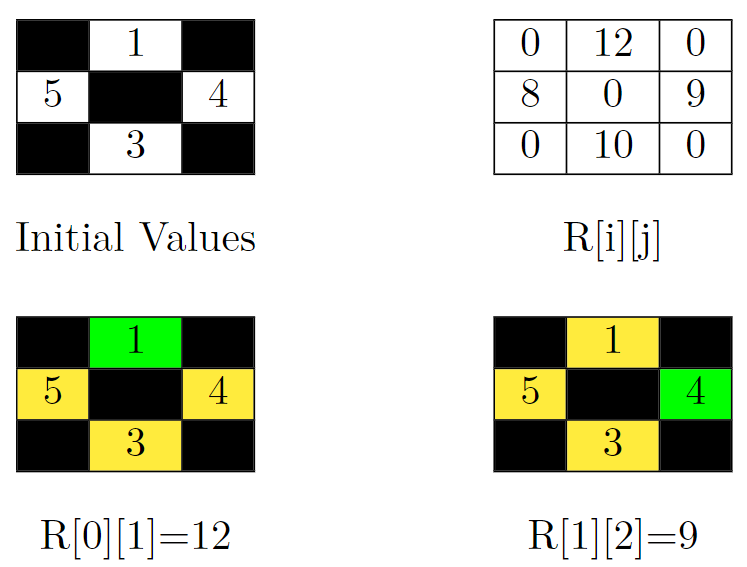
Input: grid = [[-1,1,-1],[5,-1,4],[-1,3,-1]]
Output: 39
Explanation: In the picture above, there are four grids. The top-left grid contains the initial values in the grid. Blocked cells are colored black, and other cells get their values as it is in the input. In the top-right grid, you can see the value of R[i][j] for all cells. So the answer would be the sum of them. That is: 0 + 12 + 0 + 8 + 0 + 9 + 0 + 10 + 0 = 39.
Let's jump on the bottom-left grid in the above picture and calculate R[0][1] (the target cell is colored green). We should sum up the value of cells that can't be reached by the cell (0, 1). These cells are colored yellow in this grid. So R[0][1] = 5 + 4 + 3 = 12.
Now let's jump on the bottom-right grid in the above picture and calculate R[1][2] (the target cell is colored green). We should sum up the value of cells that can't be reached by the cell (1, 2). These cells are colored yellow in this grid. So R[1][2] = 1 + 5 + 3 = 9.
Example 2:
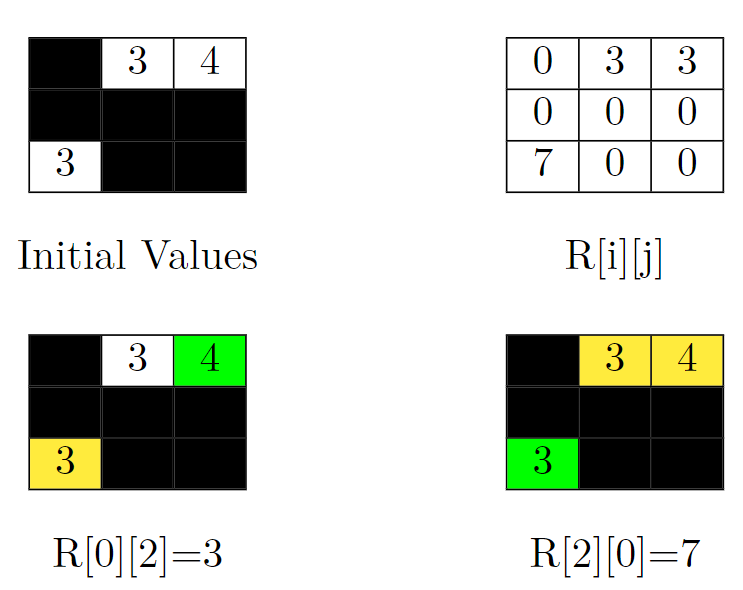
Input: grid = [[-1,3,4],[-1,-1,-1],[3,-1,-1]]
Output: 13
Explanation: In the picture above, there are four grids. The top-left grid contains the initial values in the grid. Blocked cells are colored black, and other cells get their values as it is in the input. In the top-right grid, you can see the value of R[i][j] for all cells. So the answer would be the sum of them. That is: 3 + 3 + 0 + 0 + 0 + 0 + 7 + 0 + 0 = 13.
Let's jump on the bottom-left grid in the above picture and calculate R[0][2] (the target cell is colored green). We should sum up the value of cells that can't be reached by the cell (0, 2). This cell is colored yellow in this grid. So R[0][2] = 3.
Now let's jump on the bottom-right grid in the above picture and calculate R[2][0] (the target cell is colored green). We should sum up the value of cells that can't be reached by the cell (2, 0). These cells are colored yellow in this grid. So R[2][0] = 3 + 4 = 7.
Example 3:
Input: grid = [[1]]
Output: 0
Explanation: Since there are no other cells than (0, 0), R[0][0] is equal to 0. So the sum of R[i][j] over all cells would be 0.
Constraints:
1 <= n <= 3001 <= grid[i][j] <= 106orgrid[i][j] == -1
Asked at 1 company
Topics
Hints open one at a time
Hint 1
We consider each cell of
grid a node on a graph, and there is an edge between two nodes if one of them doesn't contain -1 and they share an edge on the grid.Hint 2
We find the connected components of said graph.
Hint 3
The nodes of each connected component have the same value for
R and it's the sum of the values of all nodes in other connected components.Loading editor…
1class Solution:
2 def solve(self):
3 pass
4
Starter codePython 3Spaces: 4
Loading editor…
1class Solution:
2 def solve(self):
3 pass
4
Starter codePython 3Spaces: 4
Examples
Input
[[-1,1,-1],[5,-1,4],[-1,3,-1]]
Input
[[-1,3,4],[-1,-1,-1],[3,-1,-1]]
Input
[[1]]
Your code is saved on this device.Solution