3924. Minimum Threshold Path With Limited Heavy Edges
There is an undirected weighted graph with n nodes labeled from 0 to n - 1.
The graph is represented by a 2D integer array edges, where each edge edges[i] = [ui, vi, wi] indicates that there is an undirected edge between nodes ui and vi with weight wi.
You are also given integers source, target and k.
A threshold value determines whether an edge is considered light or heavy:
-
An edge is light if its weight is less than or equal to
threshold. -
An edge is heavy if its weight is greater than
threshold.
A path from source to target is valid if it contains at most k heavy edges.
Return the minimum integer threshold such that at least one valid path exists from source to target. If no such path exists, return -1.
Example 1:
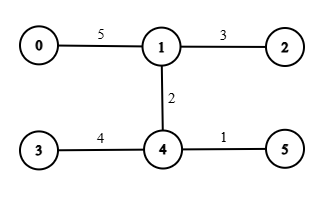
Input: n = 6, edges = [[0,1,5],[1,2,3],[3,4,4],[4,5,1],[1,4,2]], source = 0, target = 3, k = 1
Output: 4
Explanation:
The minimum threshold such that a path from node 0 to node 3 uses at most 1 heavy edge is 4.
-
Light edges:
[1, 2, 3],[3, 4, 4],[4, 5, 1],[1, 4, 2] -
Heavy edges:
[0, 1, 5]
A valid path is 0 → 1 → 4 → 3. It uses only 1 heavy edge ([0, 1, 5]), which satisfies the limit k = 1.
Any smaller threshold would make it impossible to reach node 3 without exceeding 1 heavy edge.
Example 2:
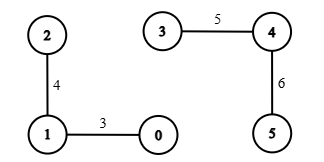
Input: n = 6, edges = [[0,1,3],[1,2,4],[3,4,5],[4,5,6]], source = 0, target = 4, k = 1
Output: -1
Explanation:
There is no path from node 0 to node 4. Since the target cannot be reached, the output is -1.
Example 3:
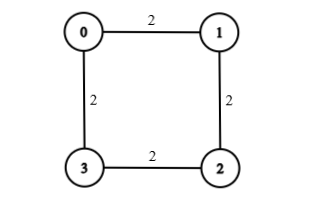
Input: n = 4, edges = [[0,1,2],[1,2,2],[2,3,2],[3,0,2]], source = 0, target = 0, k = 0
Output: 0
Explanation:
The source and target are the same node. No edges need to be traversed, so the minimum threshold is 0.
Constraints:
1 <= n <= 1030 <= edges.length <= 103edges[i] = [ui, vi, wi]0 <= ui, vi <= n - 11 <= wi <= 1090 <= source, target <= n - 10 <= k <= edges.length
Loading editor...
6
[[0,1,5],[1,2,3],[3,4,4],[4,5,1],[1,4,2]]
0
3
1