2204. Distance to a Cycle in Undirected Graph
You are given a positive integer n representing the number of nodes in a connected undirected graph containing exactly one cycle. The nodes are numbered from 0 to n - 1 (inclusive).
You are also given a 2D integer array edges, where edges[i] = [node1i, node2i] denotes that there is a bidirectional edge connecting node1i and node2i in the graph.
The distance between two nodes a and b is defined to be the minimum number of edges that are needed to go from a to b.
Return an integer array answer of size n, where answer[i] is the minimum distance between the ith node and any node in the cycle.
Example 1:
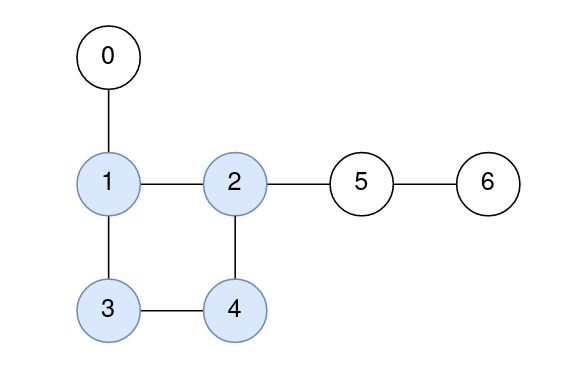
Input: n = 7, edges = [[1,2],[2,4],[4,3],[3,1],[0,1],[5,2],[6,5]]
Output: [1,0,0,0,0,1,2]
Explanation:
The nodes 1, 2, 3, and 4 form the cycle.
The distance from 0 to 1 is 1.
The distance from 1 to 1 is 0.
The distance from 2 to 2 is 0.
The distance from 3 to 3 is 0.
The distance from 4 to 4 is 0.
The distance from 5 to 2 is 1.
The distance from 6 to 2 is 2.
Example 2:
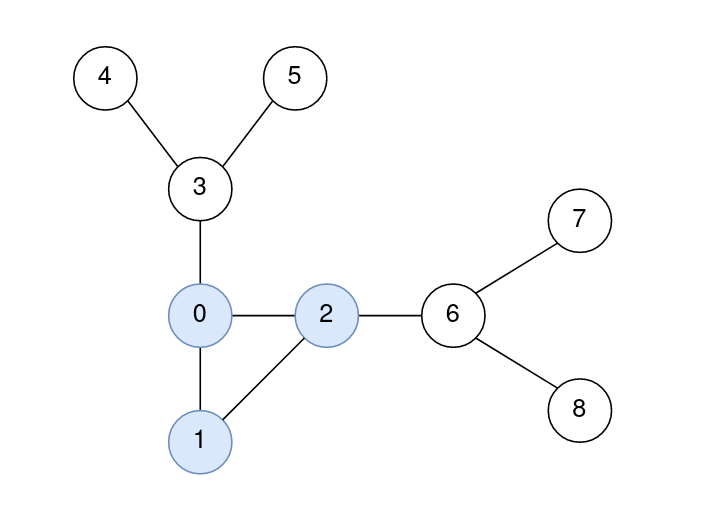
Input: n = 9, edges = [[0,1],[1,2],[0,2],[2,6],[6,7],[6,8],[0,3],[3,4],[3,5]]
Output: [0,0,0,1,2,2,1,2,2]
Explanation:
The nodes 0, 1, and 2 form the cycle.
The distance from 0 to 0 is 0.
The distance from 1 to 1 is 0.
The distance from 2 to 2 is 0.
The distance from 3 to 1 is 1.
The distance from 4 to 1 is 2.
The distance from 5 to 1 is 2.
The distance from 6 to 2 is 1.
The distance from 7 to 2 is 2.
The distance from 8 to 2 is 2.
Constraints:
3 <= n <= 105edges.length == nedges[i].length == 20 <= node1i, node2i <= n - 1node1i != node2i- The graph is connected.
- The graph has exactly one cycle.
- There is at most one edge between any pair of vertices.
Topics
Hints open one at a time
Hint 1
This problem can be broken down into two parts: finding the cycle, and finding the distance between each node and the cycle.
Hint 2
How can we find the cycle? We can use DFS and keep track of the nodes we’ve seen, and the order that we see them in. Once we see a node we’ve already visited, we know that the cycle contains the node that was seen twice and all the nodes that we visited in between.
Hint 3
Now that we know which nodes are part of the cycle, how can we find the distances? We can run a multi-source BFS starting from the nodes in the cycle and expanding outward.
Similar problems
Paths in Maze That Lead to Same RoomMediumLoading editor…
1class Solution:
2 def solve(self):
3 pass
4
Starter codePython 3Spaces: 4
Loading editor…
1class Solution:
2 def solve(self):
3 pass
4
Starter codePython 3Spaces: 4
Examples
Input
7
[[1,2],[2,4],[4,3],[3,1],[0,1],[5,2],[6,5]]
Input
9
[[0,1],[1,2],[0,2],[2,6],[6,7],[6,8],[0,3],[3,4],[3,5]]
Your code is saved on this device.Solution