3242. Design Neighbor Sum Service
You are given a n x n 2D array grid containing distinct elements in the range [0, n2 - 1].
Implement the NeighborSum class:
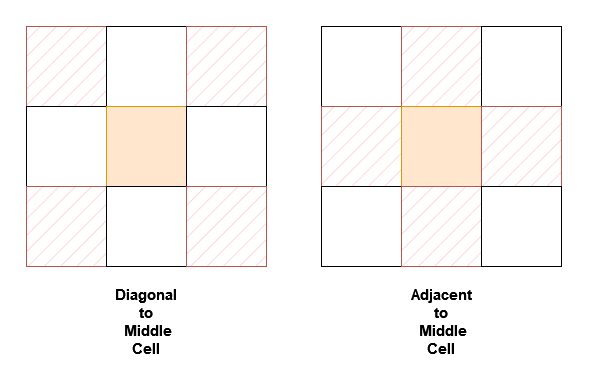
NeighborSum(int [][]grid)initializes the object.int adjacentSum(int value)returns the sum of elements which are adjacent neighbors ofvalue, that is either to the top, left, right, or bottom ofvalueingrid.int diagonalSum(int value)returns the sum of elements which are diagonal neighbors ofvalue, that is either to the top-left, top-right, bottom-left, or bottom-right ofvalueingrid.
Example 1:
Input:
["NeighborSum", "adjacentSum", "adjacentSum", "diagonalSum", "diagonalSum"]
[[[[0, 1, 2], [3, 4, 5], [6, 7, 8]]], [1], [4], [4], [8]]
Output: [null, 6, 16, 16, 4]
Explanation:
- The adjacent neighbors of 1 are 0, 2, and 4.
- The adjacent neighbors of 4 are 1, 3, 5, and 7.
- The diagonal neighbors of 4 are 0, 2, 6, and 8.
- The diagonal neighbor of 8 is 4.
Example 2:
Input:
["NeighborSum", "adjacentSum", "diagonalSum"]
[[[[1, 2, 0, 3], [4, 7, 15, 6], [8, 9, 10, 11], [12, 13, 14, 5]]], [15], [9]]
Output: [null, 23, 45]
Explanation:
- The adjacent neighbors of 15 are 0, 10, 7, and 6.
- The diagonal neighbors of 9 are 4, 12, 14, and 15.
Constraints:
3 <= n == grid.length == grid[0].length <= 100 <= grid[i][j] <= n2 - 1- All
grid[i][j]are distinct. valueinadjacentSumanddiagonalSumwill be in the range[0, n2 - 1].- At most
2 * n2calls will be made toadjacentSumanddiagonalSum.
Topics
Hints open one at a time
Hint 1
Find the cell
(i, j) in which the element is present.Hint 2
You can store the coordinates for each value.
Loading editor…
1class NeighborSum:
2
3 def __init__(self, grid: List[List[int]]):
4
5
6 def adjacentSum(self, value: int) -> int:
7
8
9 def diagonalSum(self, value: int) -> int:
10
11
12
13# Your NeighborSum object will be instantiated and called as such:
14# obj = NeighborSum(grid)
15# param_1 = obj.adjacentSum(value)
16# param_2 = obj.diagonalSum(value)
Starter codePython 3Spaces: 4
Examples
Input
["NeighborSum","adjacentSum","adjacentSum","diagonalSum","diagonalSum"]
[[[[0,1,2],[3,4,5],[6,7,8]]],[1],[4],[4],[8]]
Input
["NeighborSum","adjacentSum","diagonalSum"]
[[[[1,2,0,3],[4,7,15,6],[8,9,10,11],[12,13,14,5]]],[15],[9]]
Your code is saved on this device.Solution