1902. Depth of BST Given Insertion Order
You are given a 0-indexed integer array order of length n, a permutation of integers from 1 to n representing the order of insertion into a binary search tree.
A binary search tree is defined as follows:
- The left subtree of a node contains only nodes with keys less than the node's key.
- The right subtree of a node contains only nodes with keys greater than the node's key.
- Both the left and right subtrees must also be binary search trees.
The binary search tree is constructed as follows:
order[0]will be the root of the binary search tree.- All subsequent elements are inserted as the child of any existing node such that the binary search tree properties hold.
Return the depth of the binary search tree.
A binary tree's depth is the number of nodes along the longest path from the root node down to the farthest leaf node.
Example 1:
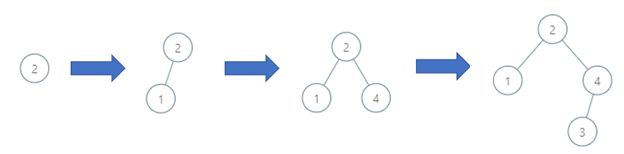
Input: order = [2,1,4,3]
Output: 3
Explanation: The binary search tree has a depth of 3 with path 2->3->4.
Example 2:
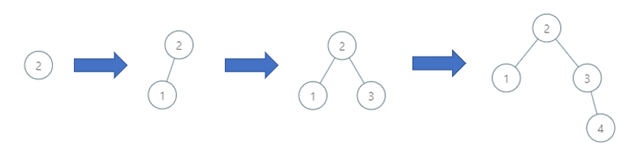
Input: order = [2,1,3,4]
Output: 3
Explanation: The binary search tree has a depth of 3 with path 2->3->4.
Example 3:
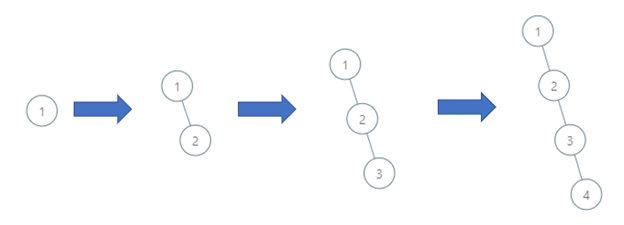
Input: order = [1,2,3,4]
Output: 4
Explanation: The binary search tree has a depth of 4 with path 1->2->3->4.
Constraints:
n == order.length1 <= n <= 105orderis a permutation of integers between1andn.
Topics
Hints open one at a time
Hint 1
There are at most 2 possible places where a new node can be inserted?
Hint 2
How can we keep track of the depth of each node?
Loading editor…
1class Solution:
2 def solve(self):
3 pass
4
Starter codePython 3Spaces: 4
Loading editor…
1class Solution:
2 def solve(self):
3 pass
4
Starter codePython 3Spaces: 4
Examples
Input
[2,1,4,3]
Input
[2,1,3,4]
Input
[1,2,3,4]
Your code is saved on this device.Solution