1110. Delete Nodes And Return Forest
Given the root of a binary tree, each node in the tree has a distinct value.
After deleting all nodes with a value in to_delete, we are left with a forest (a disjoint union of trees).
Return the roots of the trees in the remaining forest. You may return the result in any order.
Example 1:
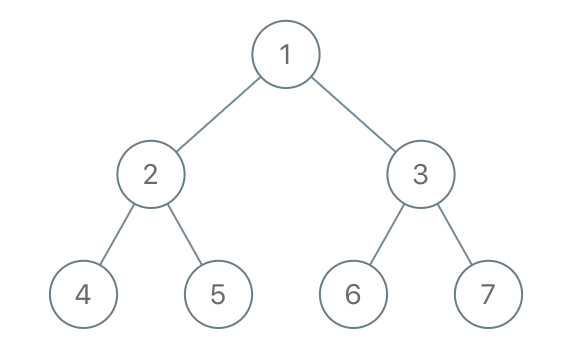
Input: root = [1,2,3,4,5,6,7], to_delete = [3,5]
Output: [[1,2,null,4],[6],[7]]
Example 2:
Input: root = [1,2,4,null,3], to_delete = [3]
Output: [[1,2,4]]
Constraints:
- The number of nodes in the given tree is at most
1000. - Each node has a distinct value between
1and1000. to_delete.length <= 1000to_deletecontains distinct values between1and1000.
 Google
Topics
Similar problems
Count Nodes With the Highest ScoreMediumLoading editor…
1# Definition for a binary tree node.
2# class TreeNode:
3# def __init__(self, val=0, left=None, right=None):
4# self.val = val
5# self.left = left
6# self.right = right
7class Solution:
8 def delNodes(self, root: Optional[TreeNode], to_delete: List[int]) -> List[TreeNode]:
9
Starter codePython 3Spaces: 4
Loading editor…
1# Definition for a binary tree node.
2# class TreeNode:
3# def __init__(self, val=0, left=None, right=None):
4# self.val = val
5# self.left = left
6# self.right = right
7class Solution:
8 def delNodes(self, root: Optional[TreeNode], to_delete: List[int]) -> List[TreeNode]:
9
Starter codePython 3Spaces: 4
Examples
Input
[1,2,3,4,5,6,7]
[3,5]
Input
[1,2,4,null,3]
[3]
Your code is saved on this device.Solution