
In the universe Earth C-137, Rick discovered a special form of magnetic force between two balls if they are put in his new invented basket. Rick has n empty baskets, the ith basket is at position[i], Morty has m balls and needs to distribute the balls into the baskets such that the minimum magnetic force between any two balls is maximum.
Rick stated that magnetic force between two different balls at positions x and y is |x - y|.
Given the integer array position and the integer m. Return the required force.
Example 1:
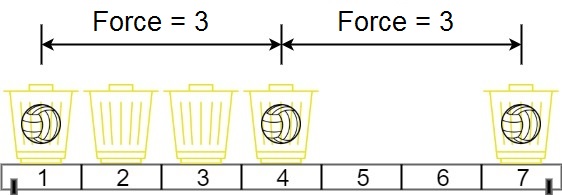
Input: position = [1,2,3,4,7], m = 3
Output: 3
Explanation: Distributing the 3 balls into baskets 1, 4 and 7 will make the magnetic force between ball pairs [3, 3, 6]. The minimum magnetic force is 3. We cannot achieve a larger minimum magnetic force than 3.
Example 2:
Input: position = [5,4,3,2,1,1000000000], m = 2
Output: 999999999
Explanation: We can use baskets 1 and 1000000000.
Constraints:
n == position.length2 <= n <= 1051 <= position[i] <= 109position are distinct.2 <= m <= position.lengthThe key challenge in #1552 Magnetic Force Between Two Balls is to place m balls in given basket positions so that the minimum distance between any two balls is maximized. A brute force search over all placements would be inefficient, so we use a combination of sorting and binary search.
First, sort the basket positions to make distance comparisons easier. Then perform a binary search on the answer, where the search space represents the possible minimum magnetic force (distance). For each candidate distance, use a greedy placement strategy: place the first ball in the first basket and continue placing balls in the next basket that maintains at least the required distance.
If you can place all m balls successfully, the distance is feasible and you try a larger value. Otherwise, reduce the search space. Sorting costs O(n log n), and each binary search check runs in O(n), giving an overall time complexity of O(n log n + n log R), where R is the distance range.
| Approach | Time Complexity | Space Complexity |
|---|---|---|
| Sorting + Binary Search with Greedy Placement | O(n log n + n log R) | O(1) |
codestorywithMIK
Use these hints if you're stuck. Try solving on your own first.
If you can place balls such that the answer is x then you can do it for y where y < x.
Similarly if you cannot place balls such that the answer is x then you can do it for y where y > x.
Binary search on the answer and greedily see if it is possible.
The problem can be solved efficiently using a binary search on the minimum magnetic force. Start by sorting the basket positions, then perform a binary search to find the maximum valid minimum force. The basic idea is to check if it is possible to place all the balls with at least a certain minimum distance (force) between any two of them. If it is possible, try for a larger minimum distance, otherwise try smaller.
Time Complexity: O(n log(n) + log(maxDistance) * n), where n is the number of baskets.
Space Complexity: O(1)
1function canPlaceBalls(position, m, minDist) {
2    let count = 1, lastPosition = position[0];
3    for (let i = 1;
The JavaScript function begins by sorting the positions array. By applying a binary search, we determine the greatest minimum separation achievable among balls. The auxiliary function `canPlaceBalls` facilitates the feasibility checks during binary search.
This approach involves using a binary search for determining the optimal force, aided by a greedy strategy to verify if a particular minimum force is attainable. By iterating over the sorted positions, balls are placed as far apart as possible greedily.
Time Complexity: O(n log(n) + n log(maxDistance)), where n is the number of baskets.
Space Complexity: O(1)
1#include <vector>
#include <algorithm>

bool canPlaceBalls(const std::vector<int>& position, int m, int dist) {
    int count = 1, last_position = position[0];
    for (size_t i = 1; i < position.size(); ++i) {
        if (position[i] - last_position >= dist) {
            count++;
            last_position = position[i];
            if (count == m) {
                 return true;
            }
        }
    }
    return false;
}

int maxDistance(std::vector<int>& position, int m) {
    std::sort(position.begin(), position.end());
    int left = 1, right = position.back() - position.front();
    while (left < right) {
        int mid = left + (right - left + 1) / 2;
        if (canPlaceBalls(position, m, mid)) {
            left = mid;
        } else {
            right = mid - 1;
        }
    }
    return left;
}

int main() {
    std::vector<int> position = {5, 4, 3, 2, 1, 1000000000};
    int m = 2;
    std::cout << maxDistance(position, m) << std::endl;
    return 0;
}Watch expert explanations and walkthroughs
Practice problems asked by these companies to ace your technical interviews.
Explore More ProblemsJot down your thoughts, approach, and key learnings
Binary search is used because the answer (maximum minimum distance) lies within a numeric range and the feasibility of a distance can be checked efficiently. This allows us to narrow down the optimal value instead of trying every possible placement.
Yes, this type of problem is common in technical interviews because it tests binary search on the answer, greedy reasoning, and array manipulation. Variants of this pattern frequently appear in FAANG-style interview questions.
An array is sufficient for this problem. After sorting the array of basket positions, a simple greedy traversal is used during each feasibility check in the binary search process.
The optimal approach combines sorting with binary search on the answer. After sorting the basket positions, you binary search the maximum minimum distance and use a greedy check to verify if m balls can be placed with that distance.
The C++ solution follows a binary search augmented by a greedy placing method to determine the largest minimum force. The `canPlaceBalls` method applies a linear traversal to determine if the midpoint force is feasible.