
There is an undirected graph with n nodes, where each node is numbered between 0 and n - 1. You are given a 2D array graph, where graph[u] is an array of nodes that node u is adjacent to. More formally, for each v in graph[u], there is an undirected edge between node u and node v. The graph has the following properties:
graph[u] does not contain u).graph[u] does not contain duplicate values).v is in graph[u], then u is in graph[v] (the graph is undirected).u and v such that there is no path between them.A graph is bipartite if the nodes can be partitioned into two independent sets A and B such that every edge in the graph connects a node in set A and a node in set B.
Return true if and only if it is bipartite.
Example 1:
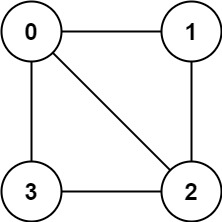
Input: graph = [[1,2,3],[0,2],[0,1,3],[0,2]]
Output: false
Explanation: There is no way to partition the nodes into two independent sets such that every edge connects a node in one and a node in the other.
Example 2:

Input: graph = [[1,3],[0,2],[1,3],[0,2]]
Output: true
Explanation: We can partition the nodes into two sets: {0, 2} and {1, 3}.
Constraints:
graph.length == n1 <= n <= 1000 <= graph[u].length < n0 <= graph[u][i] <= n - 1graph[u] does not contain u.graph[u] are unique.graph[u] contains v, then graph[v] contains u.The goal of #785 Is Graph Bipartite? is to determine whether the nodes of a graph can be split into two groups such that no two adjacent nodes belong to the same group. A common way to approach this is by graph coloring. You traverse the graph using either Breadth-First Search (BFS) or Depth-First Search (DFS) and assign alternating colors (or groups) to neighboring nodes. If at any point two connected nodes receive the same color, the graph cannot be bipartite.
During traversal, maintain a color array where each node is marked with one of two values. For disconnected graphs, you must start traversal from every unvisited node to ensure all components are checked. Another alternative approach uses Union-Find, where neighbors of each node are grouped and checked for conflicts.
Both BFS and DFS solutions efficiently explore the graph with O(V + E) time complexity, where V is the number of vertices and E is the number of edges. Space complexity mainly comes from storing colors and traversal structures.
| Approach | Time Complexity | Space Complexity |
|---|---|---|
| BFS / DFS Graph Coloring | O(V + E) | O(V) |
| Union-Find | O(E α(V)) | O(V) |
take U forward
This approach uses breadth-first search (BFS) to try and color the graph using two colors, validating its bipartiteness. By starting at any unvisited node and attempting to color it with one color, you color all its neighbors with an alternating color. If at any point a neighbor is found to already have the same color, then the graph cannot be bipartite.
The time complexity is O(V + E) where V is the number of vertices and E is the number of edges, as each edge and vertex is visited once in BFS. The space complexity is O(V) due to the storage needed for the color array and the BFS queue.
1#include <iostream>
2#include <vector>
3#include <queue>
4using namespace std;
5
6bool bfsCheck(int start, vector<vector<int>>& graph, vector<int>& colors) {
7    queue<int> q;
8    q.push(start);
9    colors[start] = 0;
10
11    while (!q.empty()) {
12        int node = q.front();
13        q.pop();
14
        for (int neighbor : graph[node]) {
            if (colors[neighbor] == -1) {
                colors[neighbor] = 1 - colors[node];
                q.push(neighbor);
            } else if (colors[neighbor] == colors[node]) {
                return false;
            }
        }
    }
    return true;
}

bool isBipartite(vector<vector<int>>& graph) {
    int n = graph.size();
    vector<int> colors(n, -1);

    for (int i = 0; i < n; ++i) {
        if (colors[i] == -1) {
            if (!bfsCheck(i, graph, colors)) {
                return false;
            }
        }
    }
    return true;
}

int main() {
    vector<vector<int>> graph = {{1, 3}, {0, 2}, {1, 3}, {0, 2}};
    cout << (isBipartite(graph) ? "true" : "false") << endl;
    return 0;
}In this C++ implementation, the graph is represented using an adjacency list (vector of vectors). The bfsCheck function is responsible for conducting a BFS on unvisited nodes, trying to color adjacent nodes with alternating colors. A same-color conflict during the traversal indicates the graph is non-bipartite.
The depth-first search (DFS) approach is an alternative to BFS for examining bipartiteness. You use DFS recursively to color the graph and check for conflicts. The method still involves checking whether adjacent nodes have opposing colors, iterating through components one by one as needed.
The time complexity is O(V + E), and the space complexity is O(V) due to recursive depth stack space utilization.
1
public class BipartiteGraphDFS {
    public bool DfsCheck(int node, int color, int[][] graph, int[] colors) {
        colors[node] = color;

        foreach (int neighbor in graph[node]) {
            if (colors[neighbor] == -1) {
                if (!DfsCheck(neighbor, 1 - color, graph, colors)) return false;
            } else if (colors[neighbor] == colors[node]) {
                return false;
            }
        }
        return true;
    }

    public bool IsBipartite(int[][] graph) {
        int n = graph.Length;
        int[] colors = new int[n];
        Array.Fill(colors, -1);

        for (int i = 0; i < n; i++) {
            if (colors[i] == -1) {
                if (!DfsCheck(i, 0, graph, colors)) {
                    return false;
                }
            }
        }
        return true;
    }

    public static void Main() {
        BipartiteGraphDFS bg = new BipartiteGraphDFS();
        int[][] graph = new int[][] {
            new int[] {1, 3}, new int[] {0, 2},
            new int[] {1, 3}, new int[] {0, 2}
        };
        Console.WriteLine(bg.IsBipartite(graph));
    }
}Watch expert explanations and walkthroughs
Practice problems asked by these companies to ace your technical interviews.
Explore More ProblemsJot down your thoughts, approach, and key learnings
Yes, Union-Find can also detect bipartite conflicts by grouping neighbors and checking whether a node ends up in the same set as one of its adjacent nodes. However, BFS or DFS coloring is usually simpler and more commonly used.
Yes, this problem is a classic graph traversal question and frequently appears in coding interviews at large tech companies. It tests understanding of graph representation, traversal, and bipartite graph properties.
The most common approach is to use BFS or DFS with graph coloring. Each node is assigned one of two colors while traversing the graph. If two adjacent nodes ever share the same color, the graph is not bipartite.
An adjacency list combined with a color array works best for this problem. BFS typically uses a queue while DFS uses recursion or a stack to traverse nodes and assign alternating colors.
In C#, DFS implemented with recursion checks each node and recurses with opposite coloring, which upon failure returns a false condition back through the method calls, terminating at its invocation point in IsBipartite when a mismatch is confirmed.