
There is a 2D grid of size n x n where each cell of this grid has a lamp that is initially turned off.
You are given a 2D array of lamp positions lamps, where lamps[i] = [rowi, coli] indicates that the lamp at grid[rowi][coli] is turned on. Even if the same lamp is listed more than once, it is turned on.
When a lamp is turned on, it illuminates its cell and all other cells in the same row, column, or diagonal.
You are also given another 2D array queries, where queries[j] = [rowj, colj]. For the jth query, determine whether grid[rowj][colj] is illuminated or not. After answering the jth query, turn off the lamp at grid[rowj][colj] and its 8 adjacent lamps if they exist. A lamp is adjacent if its cell shares either a side or corner with grid[rowj][colj].
Return an array of integers ans, where ans[j] should be 1 if the cell in the jth query was illuminated, or 0 if the lamp was not.
Example 1:
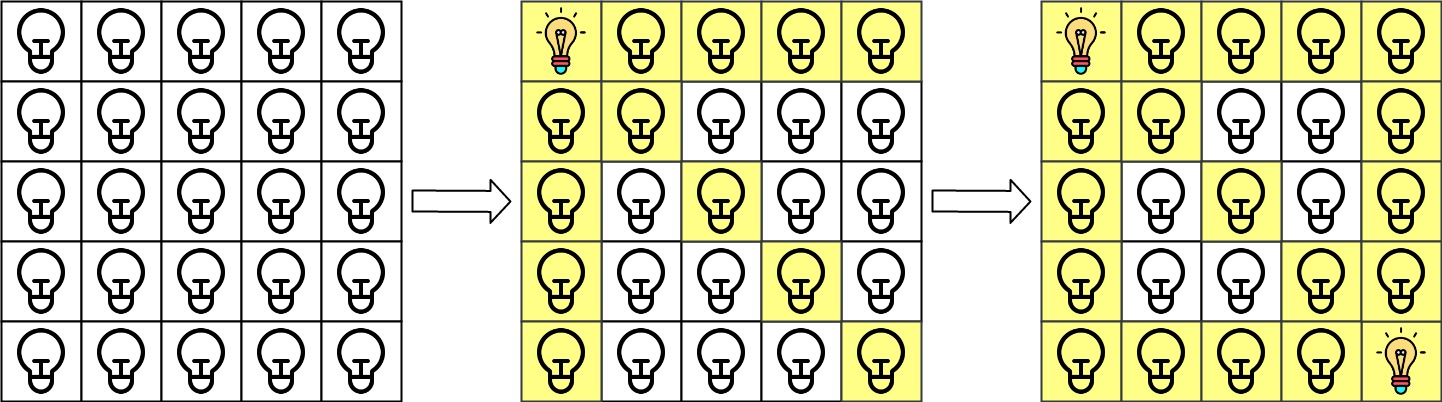
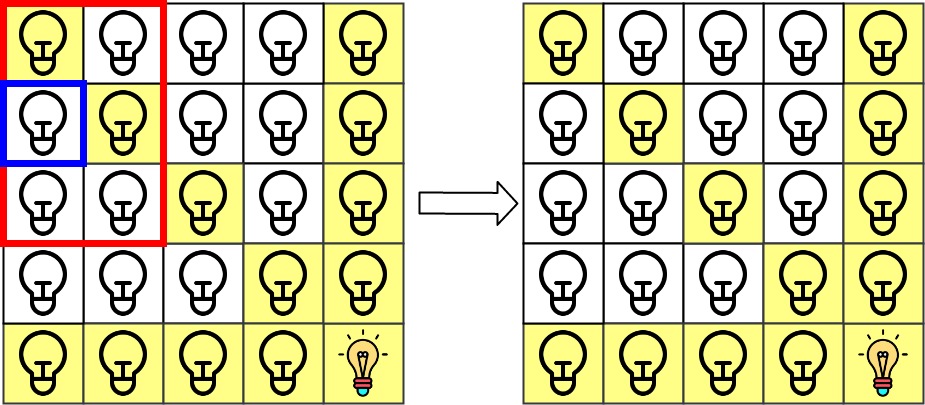
Input: n = 5, lamps = [[0,0],[4,4]], queries = [[1,1],[1,0]] Output: [1,0] Explanation: We have the initial grid with all lamps turned off. In the above picture we see the grid after turning on the lamp at grid[0][0] then turning on the lamp at grid[4][4]. The 0th query asks if the lamp at grid[1][1] is illuminated or not (the blue square). It is illuminated, so set ans[0] = 1. Then, we turn off all lamps in the red square.The 1st query asks if the lamp at grid[1][0] is illuminated or not (the blue square). It is not illuminated, so set ans[1] = 0. Then, we turn off all lamps in the red rectangle.
Example 2:
Input: n = 5, lamps = [[0,0],[4,4]], queries = [[1,1],[1,1]]
Output: [1,1]
Example 3:
Input: n = 5, lamps = [[0,0],[0,4]], queries = [[0,4],[0,1],[1,4]]
Output: [1,1,0]
Constraints:
1 <= n <= 1090 <= lamps.length <= 200000 <= queries.length <= 20000lamps[i].length == 20 <= rowi, coli < nqueries[j].length == 20 <= rowj, colj < nThe Grid Illumination problem involves tracking which cells in an n x n grid are illuminated by lamps. A lamp illuminates its entire row, column, and both diagonals. The main challenge is efficiently answering multiple queries while dynamically turning off lamps in the queried cell and its neighbors.
An efficient approach uses hash maps (or counters) to track how many active lamps affect each row, column, and diagonal. Additionally, a set is used to store active lamp positions for quick lookup and removal. For each query, we check whether the row, column, or diagonal counters are non-zero to determine if the cell is illuminated. After processing a query, lamps in the surrounding 3x3 area are removed and the counters are updated accordingly.
This design avoids scanning the entire grid and ensures efficient updates. The resulting solution processes lamp setup and queries using near constant-time hash operations.
| Approach | Time Complexity | Space Complexity |
|---|---|---|
| Hash maps for rows, columns, and diagonals with lamp set | O(L + Q) | O(L) |
Dave Burji
Watch expert explanations and walkthroughs
Practice problems asked by these companies to ace your technical interviews.
Explore More ProblemsJot down your thoughts, approach, and key learnings
Yes, Grid Illumination represents the type of hash table and simulation problem commonly asked in FAANG-style interviews. It tests data structure design, efficient state tracking, and handling multiple queries efficiently.
Hash maps and hash sets are the most suitable data structures. They allow constant-time updates and lookups for rows, columns, diagonals, and lamp positions, which is critical for handling large grids and many queries.
The optimal approach uses hash tables to track counts of active lamps affecting each row, column, and diagonal. A set stores lamp coordinates for fast existence checks and removal when queries deactivate nearby lamps.
A lamp illuminates both diagonals, so we track them using identifiers like (row - col) and (row + col). This allows quick checks to determine whether a query cell is illuminated without scanning the grid.