There are n unique candies (labeled 1 through n) and k bags. You are asked to distribute all the candies into the bags such that every bag has at least one candy.
There can be multiple ways to distribute the candies. Two ways are considered different if the candies in one bag in the first way are not all in the same bag in the second way. The order of the bags and the order of the candies within each bag do not matter.
For example, (1), (2,3) and (2), (1,3) are considered different because candies 2 and 3 in the bag (2,3) in the first way are not in the same bag in the second way (they are split between the bags (2) and (1,3)). However, (1), (2,3) and (3,2), (1) are considered the same because the candies in each bag are all in the same bags in both ways.
Given two integers, n and k, return the number of different ways to distribute the candies. As the answer may be too large, return it modulo 109 + 7.
Example 1:
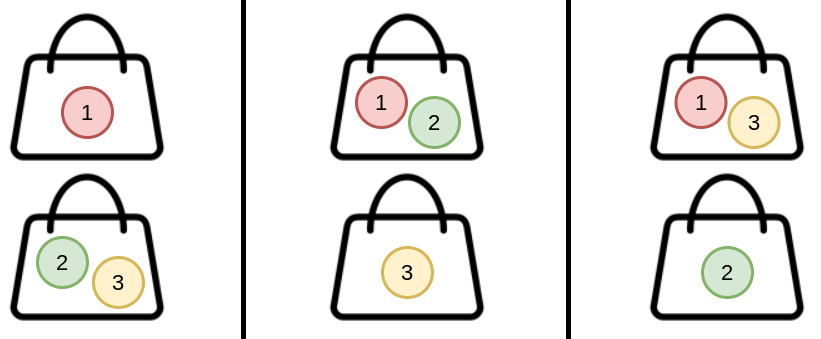
Input: n = 3, k = 2
Output: 3
Explanation: You can distribute 3 candies into 2 bags in 3 ways:
(1), (2,3)
(1,2), (3)
(1,3), (2)
Example 2:
Input: n = 4, k = 2
Output: 7
Explanation: You can distribute 4 candies into 2 bags in 7 ways:
(1), (2,3,4)
(1,2), (3,4)
(1,3), (2,4)
(1,4), (2,3)
(1,2,3), (4)
(1,2,4), (3)
(1,3,4), (2)
Example 3:
Input: n = 20, k = 5
Output: 206085257
Explanation: You can distribute 20 candies into 5 bags in 1881780996 ways. 1881780996 modulo 109 + 7 = 206085257.
Constraints:
1 <= k <= n <= 1000Problem Overview: You have n candies and k children. Each child must receive at least one candy. The task is to count how many distinct ways you can distribute the candies while satisfying this constraint. The result is returned modulo 1e9 + 7.
Approach 1: Recursive Enumeration (Exponential Time)
The most direct idea is to try every possible assignment of candies to children while ensuring every child receives at least one. A recursive function decides whether the current candy starts a new group or joins an existing one. This brute-force exploration quickly explodes because every candy can branch into multiple placements. The time complexity is exponential O(k^n) and the recursion stack uses O(n) space. This approach mainly helps you understand the structure of the recurrence before applying dynamic programming.
Approach 2: 2D Dynamic Programming (O(nk) time, O(nk) space)
Define dp[i][j] as the number of ways to distribute i candies among j children so that every child has at least one candy. When adding the i‑th candy, two choices exist. Start a new group for a child who previously had none (dp[i-1][j-1]) or give the candy to one of the j children who already has candies (j * dp[i-1][j]). The recurrence becomes dp[i][j] = dp[i-1][j-1] + j * dp[i-1][j]. Iterate i from 1 to n and j from 1 to k. This recurrence is closely related to Stirling numbers of the second kind from combinatorics. Time complexity is O(nk) and space complexity is O(nk).
Approach 3: Space Optimized Dynamic Programming (O(nk) time, O(k) space)
The DP transition only depends on the previous row i-1. You can compress the table into a single 1D array where dp[j] represents ways for the current candy count. Iterate candies one by one and update children counts from k down to 1 so previous values are not overwritten. Apply the same transition dp[j] = dp[j-1] + j * dp[j] (modulo 1e9+7). This keeps the time complexity O(nk) but reduces space to O(k). This version is usually preferred in interviews because it shows mastery of DP state transitions and memory optimization.
Recommended for interviews: The 2D DP clearly demonstrates the recurrence and is the easiest way to explain the reasoning. After presenting it, reduce space to a 1D DP array to show optimization skills. Interviewers typically expect the O(nk) dynamic programming solution with the recurrence dp[i][j] = dp[i-1][j-1] + j * dp[i-1][j].
We define f[i][j] as the number of different ways to distribute i candies to j bags. Initially, f[0][0]=1, and the answer is f[n][k].
We consider how to distribute the i-th candy. If the i-th candy is distributed to a new bag, then f[i][j]=f[i-1][j-1]. If the i-th candy is distributed to an existing bag, then f[i][j]=f[i-1][j]times j. Therefore, the state transition equation is:
$
f[i][j]=f[i-1][j-1]+f[i-1][j]times j
The final answer is f[n][k].
The time complexity is O(n times k), and the space complexity is O(n times k). Here, n and k$ are the number of candies and bags, respectively.
Python
Java
C++
Go
TypeScript
| Approach | Time | Space | When to Use |
|---|---|---|---|
| Recursive Enumeration | O(k^n) | O(n) | Conceptual understanding of the recurrence before optimization |
| 2D Dynamic Programming | O(nk) | O(nk) | Clear implementation and easiest to explain during interviews |
| 1D Space Optimized DP | O(nk) | O(k) | When memory matters or when optimizing the DP transition |
Leetcode 1692. Count Ways to Distribute Candies • Fearless Learner • 331 views views
Watch 1 more video solutions →Practice Count Ways to Distribute Candies with our built-in code editor and test cases.
Practice on FleetCode