Research Scientist: ₹56,100/month + DA + HRA. Junior Research Fellow: ₹37,000/month + HRA.
Research Scientist initially 1 year extendable up to 3 years. JRF initially 1 year and extendable up to 5 years based on project duration and performance.
First class B.Tech, M.Tech, M.Sc, or equivalent depending on role with minimum 60–65% marks. JRF candidates must qualify NET, GATE, JAM, or equivalent national eligibility tests.
Typed biodata in prescribed format, academic certificates, self‑attested photocopies, NET/GATE scorecard, experience proof if applicable, government ID, and NOC if employed.
Getting into ISRO usually means months of exams and waiting. This time, it’s different.
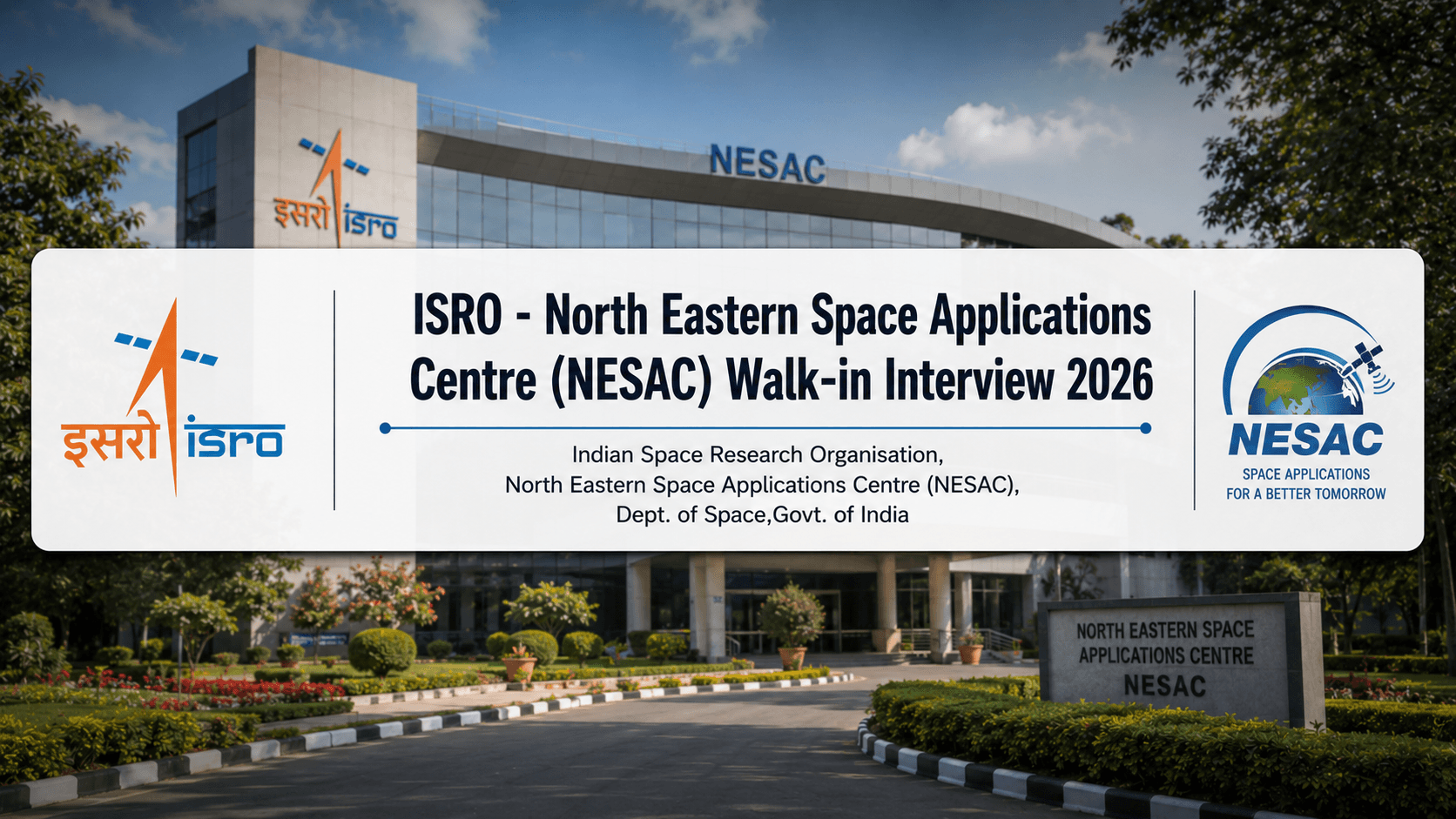
The North Eastern Space Applications Centre (NESAC), an autonomous body under the Department of Space, has announced an ISRO NESAC Walk‑in Interview 2026 for Research Scientist and Junior Research Fellow (JRF) roles. No online application portal. No written test. Eligible candidates simply show up with documents and a prescribed biodata.
If you’re from fields like remote sensing, computer science, electronics, civil engineering, or environmental science, this could be a rare chance to directly interview with an ISRO‑linked research centre. And yes, the pay is solid too.
If you’re exploring more opportunities from the space agency, you may also want to check our complete guide to ISRO Internships 2026 or browse the latest listings on the ISRO opportunities page.
Particulars Details
| Organization | North Eastern Space Applications Centre (NESAC), ISRO
| Roles Available | Research Scientist and Junior Research Fellow (JRF)
| Total Positions | Multiple (Research Scientist + 8 JRF roles)
| Interview Dates | 5 March 2026 and 6 March 2026
| Reporting Time | 08:30 AM
| Location | NESAC, Umiam, Ri‑Bhoi District, Meghalaya
| Salary (Research Scientist) | ₹56,100 per month + DA + HRA
| Stipend (JRF) | ₹37,000 per month + HRA
| Selection Process | Walk‑in Interview
| Official Page | ISRO NESAC Recruitment Page
Quick context. NESAC is not a typical satellite launch centre. Its focus is applying space technology to solve real‑world problems in India’s North‑Eastern region.
The centre works heavily with remote sensing, GIS, satellite communication, and atmospheric science. Projects often involve disaster monitoring, environmental analysis, urban planning, agriculture, and natural resource management.
That means candidates with skills in geospatial analytics, UAV data processing, hydrological modelling, or atmospheric data science will find these roles especially relevant.
Three research scientist positions are available across different technical domains.
Candidates typically need a First Class M.Tech, M.E., M.Sc., or equivalent depending on the discipline, along with at least one year of relevant work or research experience.
The monthly salary is ₹56,100 plus applicable DA and HRA. For many early‑career researchers, that’s comparable to top government research fellowships.
Eight JRF positions are available across multiple disciplines such as:
Applicants must hold a First Class M.Sc., M.Tech, B.Tech, or equivalent depending on the post, along with a valid NET, GATE, JAM, JEST, or similar national eligibility qualification.
The fellowship offered is ₹37,000 per month plus HRA. Not bad at all for a research position right out of postgraduate studies.
Here are the key academic benchmarks candidates must meet:
Age relaxations apply: 5 years for SC/ST and 3 years for OBC candidates.
The compensation structure is fairly standard for government research projects.
Research Scientist positions are initially offered for one year, extendable up to three years depending on project needs and performance.
JRF roles are project‑based and may continue up to five years, subject to annual performance review.
Worth noting: JRF candidates are encouraged to register for a PhD at recognized universities while working on NESAC projects.
The interviews will be held at:
North Eastern Space Applications Centre (NESAC)
Umiam, Ri‑Bhoi District, Meghalaya
The centre is located around 85 km from Guwahati Railway Station and roughly 18 km from Shillong.
Quick heads‑up though. No TA/DA will be provided for attending the interview, so candidates must arrange their own travel and accommodation.
I’ve seen many candidates underestimate walk‑in research interviews. That’s a mistake.
These panels often ask detailed questions about your thesis, research methods, and technical tools. If your resume mentions GIS, Python, or remote sensing workflows, expect to discuss them in depth.
Also review your dissertation carefully. Many candidates get caught off guard when interviewers ask about the methodology used in their final project.
And one practical tip. Arrive early. Walk‑in interviews at research centres often involve document verification queues before the actual interview begins.

Technical Content Writer
Radhika is a Technical Content Writer at Talentd, where she creates clear, practical, and research-driven content focused on jobs, internships, career guidance, and technology. She specializes in simplifying complex technical topics and turning them into easy-to-understand resources for students and fresh graduates. At Talentd, Radhika contributes to articles related to hiring updates, interview preparation, career roadmaps, and industry trends, helping thousands of learners stay informed and make better career decisions. Her work focuses on delivering accurate, actionable, and student-friendly content that supports the growing Talentd community.