Transform Binary String Using Subsequence Sort solution and explanation

5 more videos on this problem
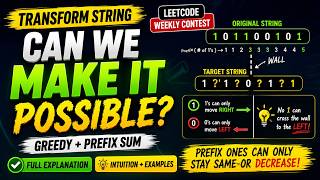 LeetCode 3998 | Weekly Contest 511 Q3 | Transform Binary String Using Subsequence Sort | Greedy + 🤯CodeSprint · 21:33 · 466 views
 3998. Transform Binary String Using Subsequence Sort (Leetcode Medium)Programming Live with Larry · 50:54 · 277 views
 LeetCode 3998 | Transform Binary String Using Subsequence Sort | Greedy + Prefix | Java | HindiCode Kage · 25:12 · 244 views
 Transform Binary String Using Subsequence Sort | LeetCode 3998 | GreedyTechdose · 28:02 · 140 views
 Leetcode contest 511 - 3998 - Transform Binary String using Subsequence SortManjeet Dhayal · 13:12 · 27 views
 3998. Transform Binary String Using Subsequence Sort #leetcode Weekly 511 Greedy Soln with Dry runBEASTCODES · 28:43 · 15 views
The problem
You are given a binary string s.
You are also given an array of strings strs, where each strs[i] has the same length as s and consists of characters '0', '1', and '?'. Each '?' can be replaced by either '0' or '1'.
You may perform the following operation any number of times (including zero):
- Choose any subsequence
subofs. - Sort
subin non-decreasing order. - Replace the chosen subsequence in
swith the sortedsub, keeping all other characters unchanged.
Return a boolean array ans, where ans[i] is true if it's possible to replace all '?' in strs[i] with '0' or '1' and transform s into the resulting string using the allowed operation above, otherwise return false.
Example 1:
Input: s = "101", strs = ["1?1","0?1","0?0"]
Output: [true,true,false]
Explanation:
i |
strs[i] |
Replacement | Result strs[i] |
Operation(s) | Result |
|---|---|---|---|---|---|
| 0 | "1?1" |
? → 0 |
"101" |
Matches s. |
true |
| 1 | "0?1" |
? → 1 |
"011" |
Select the subsequence at indices [0..2] of s → "101".Sort "101" to get "011" = strs[i]. |
true |
| 2 | "0?0" |
? → 0 or 1 |
"000" or "010" |
Not feasible. | false |
Thus, ans = [true, true, false].
Example 2:
Input: s = "1100", strs = ["0011","11?1","1?1?"]
Output: [true,false,true]
Explanation:
i |
strs[i] |
Replacement | Result strs[i] |
Operation(s) | Result |
|---|---|---|---|---|---|
| 0 | "0011" |
- | "0011" |
Select the subsequence at indices [0..3] of s → "1100".Sort "1100" to get "0011" = strs[i]. |
true |
| 1 | "11?1" |
? → 0 |
"1101" |
Not feasible. | false |
| 2 | "1?1?" |
First ? → 0Second ? → 0 |
"1010" |
Select the subsequence at indices [1, 2] of s → "10".Sort "10" to get "01", so s = "1010". |
true |
Thus, ans = [true, false, true].
Example 3:
Input: s = "1010", strs = ["0011"]
Output: [true]
Explanation:
i |
strs[i] |
Replacement | Result strs[i] |
Operation(s) | Result |
|---|---|---|---|---|---|
| 0 | "0011" |
- | "0011" |
Select the subsequence at indices [0, 2, 3] of s → "110".Sort "110" to get "011", so s = "0011" = strs[i]. |
true |
Thus, ans = [true].
Constraints:
1 <= n == s.length <= 2000s[i]is either'0'or'1'.1 <= strs.length <= 2000strs[i].length == nstrs[i]is either'0','1', or'?'.
Approach overview
Problem Overview: You need to transform a binary string into its sorted form using operations performed on subsequences. The challenge is identifying the minimum number of operations while preserving the relative constraints imposed by subsequence selection.
Approach 1: Brute Force Simulation (O(n2) time, O(n) space)
The direct approach simulates every possible subsequence operation and checks whether the string becomes sorted after each transformation. You iterate through all indices, collect misplaced characters, and repeatedly apply subsequence sorting until the string stabilizes. This works for small inputs because every operation explicitly rebuilds part of the string. The main drawback is repeated scanning and reconstruction, which makes it quadratic for larger inputs.
Approach 2: Greedy Counting with Two Pointers (O(n) time, O(1) space)
The optimal solution relies on a key observation: a binary string is already sorted if every 0 appears before every 1. You can scan the string once and track inversions where a 1 appears before a later 0. Using two pointers from both ends, or a single pass with counters, you identify the minimum subsequence adjustments needed without physically sorting after every operation. This avoids unnecessary reconstruction and reduces the runtime to linear complexity.
The greedy idea works because subsequence sorting can fix multiple misplaced characters in a single operation. Instead of thinking about individual swaps, you count how many groups of invalid ordering exist. Problems involving binary strings often reduce to counting transitions or inversions rather than simulating edits directly. Similar optimization patterns appear in greedy algorithms and two pointers problems.
Approach 3: Stack or Index Tracking Variant (O(n) time, O(n) space)
Another implementation keeps indices of misplaced 1s inside a stack or array. When a 0 appears after them, you match positions and determine whether the current subsequence operation can absorb multiple corrections. This version is easier to reason about during interviews because every mismatch is explicitly represented. The tradeoff is extra memory usage compared to the pure greedy counter approach.
Most interviewers expect the linear greedy solution because the constraints usually make quadratic simulation too slow. Showing the brute force approach first demonstrates that you understand the operation mechanics. Moving to the optimized pass shows that you can extract the invariant behind the transformation process. Problems like this commonly test pattern recognition in string algorithms rather than advanced data structures.
The written solution for this problem is still being prepared. Try it yourself in the meantime.
Try solving it yourselfComplexity analysis
| Approach | Time | Space | When to Use |
|---|---|---|---|
| Brute Force Simulation | O(n²) | O(n) | Useful for understanding subsequence operations or very small inputs |
| Greedy Counting with Two Pointers | O(n) | O(1) | Best general solution for interviews and competitive programming |
| Stack or Index Tracking | O(n) | O(n) | Helpful when you want explicit mismatch tracking for debugging |
Frequently asked questions
Is Transform Binary String Using Subsequence Sort easy or hard?
This problem is generally considered medium difficulty because the implementation is simple once the greedy observation is found. The challenging part is recognizing that repeated subsequence sorting can be reduced to counting inversion patterns.
Transform Binary String Using Subsequence Sort Python/Java solution
Python and Java implementations both follow the same greedy logic: scan the string, detect invalid binary ordering, and count the minimum operations needed. The runtime remains O(n) in both languages with constant auxiliary space.
How to solve Transform Binary String Using Subsequence Sort in O(n)?
Use a greedy observation that the final binary string must have all 0s before all 1s. Count inversions or invalid ordering patterns during a single pass and compute the minimum subsequence operations directly without rebuilding the string repeatedly.
What is the best approach for Transform Binary String Using Subsequence Sort?
The best approach is a greedy linear scan that tracks misplaced 1s and 0s instead of simulating every subsequence sort operation. This reduces the complexity to O(n) time and O(1) extra space while still handling all edge cases correctly.
Is Transform Binary String Using Subsequence Sort asked at Google/Amazon/Meta?
Binary string transformation and greedy subsequence problems appear frequently in coding interviews at companies like Amazon, Google, and Meta. Interviewers usually focus on whether you can derive the linear-time observation from the brute force simulation.
What data structure is used in Transform Binary String Using Subsequence Sort?
Most optimal solutions only require counters and two pointers. Some implementations also use a stack or array to store indices of misplaced characters, which makes the transformation logic easier to visualize.
What is the time complexity of Transform Binary String Using Subsequence Sort?
The optimal solution runs in O(n) time because the string is scanned only once or twice using counters or two pointers. Space complexity is typically O(1) unless an auxiliary stack or index list is used.