
Manhattan Distances of All Arrangements of Pieces - Solution & Explanation
Problem Statement
You are given three integers m, n, and k.
There is a rectangular grid of size m × n containing k identical pieces. Return the sum of Manhattan distances between every pair of pieces over all valid arrangements of pieces.
A valid arrangement is a placement of all k pieces on the grid with at most one piece per cell.
Since the answer may be very large, return it modulo 109 + 7.
The Manhattan Distance between two cells (xi, yi) and (xj, yj) is |xi - xj| + |yi - yj|.
Example 1:
Input: m = 2, n = 2, k = 2
Output: 8
Explanation:
The valid arrangements of pieces on the board are:
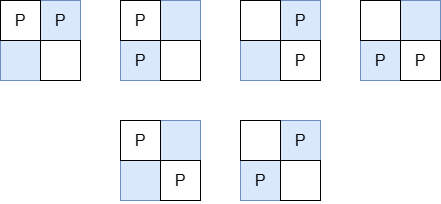

- In the first 4 arrangements, the Manhattan distance between the two pieces is 1.
- In the last 2 arrangements, the Manhattan distance between the two pieces is 2.
Thus, the total Manhattan distance across all valid arrangements is 1 + 1 + 1 + 1 + 2 + 2 = 8.
Example 2:
Input: m = 1, n = 4, k = 3
Output: 20
Explanation:
The valid arrangements of pieces on the board are:

- The first and last arrangements have a total Manhattan distance of
1 + 1 + 2 = 4. - The middle two arrangements have a total Manhattan distance of
1 + 2 + 3 = 6.
The total Manhattan distance between all pairs of pieces across all arrangements is 4 + 6 + 6 + 4 = 20.
Constraints:
1 <= m, n <= 1052 <= m * n <= 1052 <= k <= m * n
Approach Overview
Problem Overview: You place k identical pieces on an m x n grid. For every possible arrangement, compute the total Manhattan distance between every pair of pieces. The task is to return the sum of these distances across all valid arrangements.
Approach 1: Brute Force Enumeration (Exponential)
The most direct idea is to generate every way to place k pieces among the m * n cells, then compute the pairwise Manhattan distance for each arrangement. For every configuration you iterate over all k choose 2 pairs and accumulate distances. This quickly becomes infeasible because the number of arrangements is C(mn, k). Time complexity is roughly O(C(mn, k) * k^2) with O(k) space for storing positions. This approach only works for extremely small grids and mainly helps you understand what the problem is asking.
Approach 2: Pair Contribution with Combinatorics (O(m + n))
Instead of enumerating arrangements, focus on how much each pair of cells contributes to the final answer. If two cells are chosen for pieces, their Manhattan distance contributes once for every arrangement where those two cells are occupied. The number of such arrangements is C(mn - 2, k - 2) because the remaining k-2 pieces can be placed in any of the other cells.
Now compute the sum of Manhattan distances across all unordered cell pairs. Manhattan distance splits cleanly into row and column components: |r1 - r2| + |c1 - c2|. You can aggregate these independently.
For rows, consider every distance d between two rows. There are (m - d) row pairs with that difference. Each row pair combines with any column pair, giving n * n cell pairs. The total row contribution becomes sum(d * (m - d) * n^2). Do the same for columns: sum(d * (n - d) * m^2). This produces the total Manhattan distance across all cell pairs in O(m + n) time.
Finally multiply that value by C(mn - 2, k - 2). Precompute factorials and modular inverses to evaluate combinations efficiently. This solution relies heavily on combinatorics and mathematical decomposition of Manhattan distance. Time complexity is O(m + n) with O(mn) preprocessing for factorials.
Recommended for interviews: The combinatorics contribution approach is what interviewers expect. Explaining the brute force shows you understand the problem space, but recognizing that each pair of cells contributes independently demonstrates strong mathematical reasoning and familiarity with combinatorial counting.
Solutions for this problem are being prepared.
Try solving it yourselfDetailed Complexity Analysis
| Approach | Time | Space | When to Use |
|---|---|---|---|
| Brute Force Enumeration | O(C(mn, k) * k^2) | O(k) | Only for very small grids or conceptual understanding |
| Pair Contribution with Combinatorics | O(m + n) | O(mn) for factorial precomputation | Optimal solution for large constraints and interview settings |
Video Solution
Leetcode 3426. Manhattan Distances of All Arrangements of Pieces |Math Proof | Biweekly Contest 148 • By IITians • 676 views views
Watch 1 more video solutions →Frequently Asked Questions
Is Manhattan Distances of All Arrangements of Pieces easy or hard?
Manhattan Distances of All Arrangements of Pieces Python/Java solution
How to solve Manhattan Distances of All Arrangements of Pieces in O(m+n)?
What is the best approach for Manhattan Distances of All Arrangements of Pieces?
Is Manhattan Distances of All Arrangements of Pieces asked at Google/Amazon/Meta?
What data structure is used in Manhattan Distances of All Arrangements of Pieces?
What is the time complexity of Manhattan Distances of All Arrangements of Pieces?
Ready to solve this problem?
Practice Manhattan Distances of All Arrangements of Pieces with our built-in code editor and test cases.
Practice on FleetCodeTable of Contents
Practice this problem
Open in Editor