
Find Sorted Submatrices With Maximum Element at Most K - Solution & Explanation
Problem Statement
You are given a 2D matrix grid of size m x n. You are also given a non-negative integer k.
Return the number of submatrices of grid that satisfy the following conditions:
- The maximum element in the submatrix less than or equal to
k. - Each row in the submatrix is sorted in non-increasing order.
A submatrix (x1, y1, x2, y2) is a matrix that forms by choosing all cells grid[x][y] where x1 <= x <= x2 and y1 <= y <= y2.
Example 1:
Input: grid = [[4,3,2,1],[8,7,6,1]], k = 3
Output: 8
Explanation:
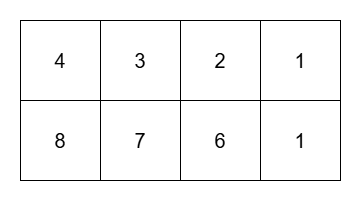
The 8 submatrices are:
[[1]][[1]][[2,1]][[3,2,1]][[1],[1]][[2]][[3]][[3,2]]
Example 2:
Input: grid = [[1,1,1],[1,1,1],[1,1,1]], k = 1
Output: 36
Explanation:
There are 36 submatrices of grid. All submatrices have their maximum element equal to 1.
Example 3:
Input: grid = [[1]], k = 1
Output: 1
Constraints:
1 <= m == grid.length <= 1031 <= n == grid[i].length <= 1031 <= grid[i][j] <= 1091 <= k <= 109
Approach Overview
Problem Overview: Given a matrix and an integer k, count submatrices that satisfy two constraints: every row inside the submatrix remains non‑decreasing (sorted left to right) and the maximum element inside the submatrix is at most k.
Approach 1: Brute Force Submatrix Enumeration (O(m^2 * n^2), O(1) space)
Enumerate every possible submatrix using four boundaries. For each candidate, scan all cells to verify two conditions: values do not exceed k and every row remains non‑decreasing across the selected columns. This approach directly checks the definition but repeats large amounts of work because each submatrix is validated from scratch. It works for very small matrices but quickly becomes infeasible as matrix size grows.
Approach 2: Row Preprocessing + Monotonic Stack (O(m * n), O(n) space)
Preprocess each cell to compute the maximum width of a valid sorted segment ending at that column. While scanning a row, extend the width if matrix[i][j] >= matrix[i][j-1] and matrix[i][j] ≤ k; otherwise reset the width to 0. This converts the matrix into a grid where each cell represents the largest valid horizontal span of a sorted segment ending there.
Now treat each column as a histogram where the value is the width computed above. For each row while moving downward, use a monotonic stack to maintain increasing widths. The stack helps determine how many submatrices can end at the current row by aggregating contributions of previous rows while maintaining the minimum width constraint. This technique is similar to counting rectangles in histogram problems and avoids recomputing ranges repeatedly.
The key insight: for a submatrix to remain sorted, the limiting factor is the minimum valid width among its rows. The monotonic stack efficiently tracks these minima while extending submatrices vertically. Combined with matrix preprocessing from matrix traversal and standard array operations, the algorithm counts all valid rectangles in linear time.
Recommended for interviews: The monotonic stack solution. Interviewers expect you to recognize the transformation from matrix constraints to a histogram-style counting problem. Mentioning the brute force method first shows you understand the constraints, but implementing the O(m * n) stack approach demonstrates strong algorithmic problem solving.
Solutions for this problem are being prepared.
Try solving it yourselfDetailed Complexity Analysis
| Approach | Time | Space | When to Use |
|---|---|---|---|
| Brute Force Submatrix Enumeration | O(m^2 * n^2) | O(1) | Conceptual baseline or when matrix size is very small |
| Row Preprocessing + Monotonic Stack | O(m * n) | O(n) | General optimal solution for large matrices |
Video Solution
Kth Largest Element in an Array - Quick Select - Leetcode 215 - Python • NeetCode • 331,616 views views
Watch 9 more video solutions →Frequently Asked Questions
Is Find Sorted Submatrices With Maximum Element at Most K easy or hard?
Find Sorted Submatrices With Maximum Element at Most K Python/Java solution
How to solve Find Sorted Submatrices With Maximum Element at Most K in O(n)?
What is the best approach for Find Sorted Submatrices With Maximum Element at Most K?
Is Find Sorted Submatrices With Maximum Element at Most K asked at Google/Amazon/Meta?
What data structure is used in Find Sorted Submatrices With Maximum Element at Most K?
What is the time complexity of Find Sorted Submatrices With Maximum Element at Most K?
Ready to solve this problem?
Practice Find Sorted Submatrices With Maximum Element at Most K with our built-in code editor and test cases.
Practice on FleetCodeProblem Info
Table of Contents
Practice this problem
Open in Editor