
Cyclically Shift Rows and Columns - Solution & Explanation
Problem Statement
You are given an integer n, a 2D integer array grid of size n x n, and two integer arrays rowShift and colShift, each of length n, where:
rowShift[i]represents the number of positions to cyclically shift theithrow ofgridto the left.colShift[j]represents the number of positions to cyclically shift thejthcolumn ofgridupward.
First, cyclically shift each row according to rowShift, then cyclically shift each column of the resulting grid according to colShift.
Return the resulting grid after performing all the shifts.
A cyclic left shift of a row by k positions moves the element at column j to column (j - k + n) % n. All other rows remain unchanged.
A cyclic upward shift of a column by k positions moves the element at row i to row (i - k + n) % n. All other columns remain unchanged.
Example 1:
Input: n = 2, grid = [[1,2],[3,4]], rowShift = [1,0], colShift = [0,1]
Output: [[2,4],[3,1]]
Explanation:
The grid changes as follows:

Example 2:
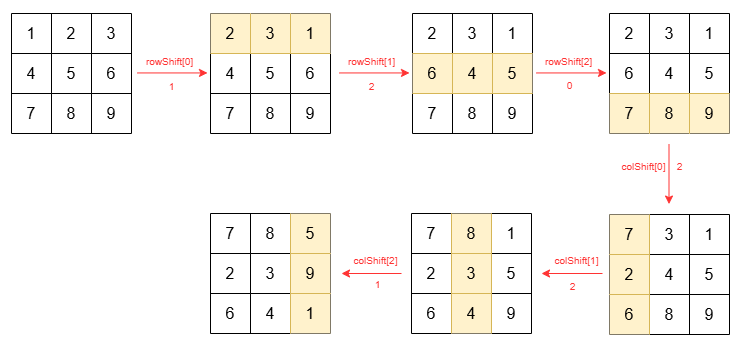
Input: n = 3, grid = [[1,2,3],[4,5,6],[7,8,9]], rowShift = [1,2,0], colShift = [2,2,1]
Output: [[7,8,5],[2,3,9],[6,4,1]]
Explanation:
The grid changes as follows:
Constraints:
1 <= n == grid.length == grid[i].length <= 101 <= grid[i][j] <= 100rowShift.length == colShift.length == n0 <= rowShift[i], colShift[i] < n
Solution
Thinking
n \le 10, so applying the two shifts exactly as stated is enough. There is no need to fold the mapping into a single index formula first.Rows must move left before columns move up, and the upward shift uses the new column index.
colShiftcannot be applied with the originalj.We therefore keep an intermediate grid for the row shifts, then write the column shifts into the answer.
The problem asks us to cyclically shift each row left according to rowShift, then cyclically shift each column up according to colShift.
Create an intermediate matrix t. After a left cyclic shift of rowShift[i], the entry grid[i][j] lands at
$
t[i][(j - rowShift[i] + n) bmod n]
Then create the answer matrix ans. After an upward cyclic shift of colShift[j], t[i][j] lands at
ans[(i - colShift[j] + n) bmod n][j]
The time complexity is O(n^2) and the space complexity is O(n^2), where n$ is the side length of the grid.
Code
Python
Java
C++
Go
TypeScript
Video Solution
LeetCode 4052 Solution | Cyclically Shift Rows and Columns | Weekly Contest 519 | C++ • Plum Codes • 48 views views
Watch 3 more video solutions →Ready to solve this problem?
Practice Cyclically Shift Rows and Columns with our built-in code editor and test cases.
Practice on FleetCodeProblem Info
Table of Contents
Practice this problem
Open in Editor