
Bomb Enemy - Solution & Explanation
Problem Statement
Given an m x n matrix grid where each cell is either a wall 'W', an enemy 'E' or empty '0', return the maximum enemies you can kill using one bomb. You can only place the bomb in an empty cell.
The bomb kills all the enemies in the same row and column from the planted point until it hits the wall since it is too strong to be destroyed.
Example 1:
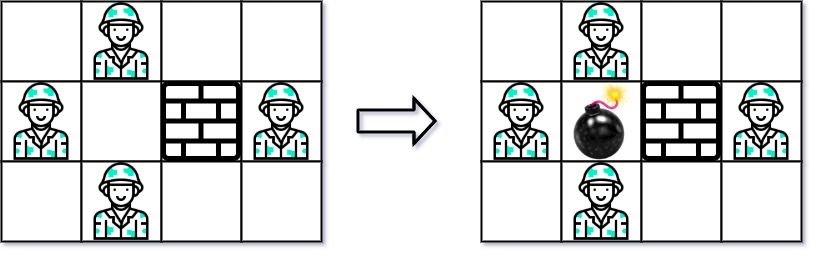
Input: grid = [["0","E","0","0"],["E","0","W","E"],["0","E","0","0"]]
Output: 3
Example 2:
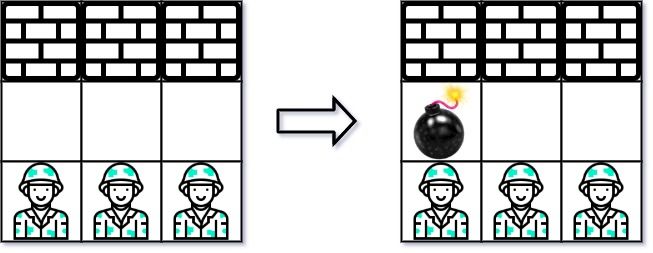
Input: grid = [["W","W","W"],["0","0","0"],["E","E","E"]]
Output: 1
Constraints:
m == grid.lengthn == grid[i].length1 <= m, n <= 500grid[i][j]is either'W','E', or'0'.
Approach Overview
Problem Overview: You are given a 2D grid containing walls (W), enemies (E), and empty cells (0). Placing a bomb in an empty cell eliminates every enemy in the same row and column until a wall blocks the blast. The task is to find the placement that kills the maximum number of enemies.
Approach 1: Brute Force Scan (O(m*n*(m+n)) time, O(1) space)
Iterate through every cell in the grid and consider placing the bomb only when the cell contains 0. From that position, scan left, right, up, and down until hitting a wall (W). Count every enemy encountered during these scans. Keep track of the maximum number of enemies killed across all valid placements. This approach is straightforward but inefficient because the same rows and columns are repeatedly scanned for many cells.
Approach 2: Row and Column Kill Caching (O(m*n) time, O(n) space)
Instead of rescanning the entire row and column for every empty cell, cache the number of enemies that can be killed in the current row segment and column segment. When you start a new row segment (either at column 0 or right after a wall), iterate forward until the next wall to count enemies and store it in rowHits. For columns, maintain an array colHits[j] representing the enemy count for the column segment starting at the current row. Recompute it only when the cell above is a wall. For each empty cell, the total kills are simply rowHits + colHits[j]. This avoids repeated scans and processes each grid cell at most a constant number of times.
The technique relies on recognizing independent row and column segments separated by walls. Once the enemy count for a segment is known, every empty cell inside that segment shares the same potential blast coverage. This transforms repeated directional scans into a linear pass across the grid.
Recommended for interviews: The row and column caching approach is the expected solution. The brute force version demonstrates understanding of the problem mechanics, but the optimized scan shows strong command of grid traversal and reuse of computed results. This pattern frequently appears in matrix traversal problems and optimization techniques related to arrays and light dynamic programming style state reuse.
Solution
Try this approach in the editor →Detailed Complexity Analysis
| Approach | Time | Space | When to Use |
|---|---|---|---|
| Brute Force Directional Scan | O(m*n*(m+n)) | O(1) | Good for understanding the problem mechanics or very small grids |
| Row and Column Kill Caching (Optimized Scan) | O(m*n) | O(n) | Optimal approach for interviews and large grids |
Video Solution
LeetCode 361. Bomb Enemy Explanation and Solution • happygirlzt • 5,089 views views
Watch 7 more video solutions →Frequently Asked Questions
Is Bomb Enemy easy or hard?
Bomb Enemy Python/Java solution
How to solve Bomb Enemy in O(n)?
What is the best approach for Bomb Enemy?
Is Bomb Enemy asked at Google/Amazon/Meta?
What data structure is used in Bomb Enemy?
What is the time complexity of Bomb Enemy?
Ready to solve this problem?
Practice Bomb Enemy with our built-in code editor and test cases.
Practice on FleetCodeTable of Contents
Practice this problem
Open in Editor