3446. Sort Matrix by Diagonals
You are given an n x n square matrix of integers grid. Return the matrix such that:
- The diagonals in the bottom-left triangle (including the middle diagonal) are sorted in non-increasing order.
- The diagonals in the top-right triangle are sorted in non-decreasing order.
Example 1:
Input: grid = [[1,7,3],[9,8,2],[4,5,6]]
Output: [[8,2,3],[9,6,7],[4,5,1]]
Explanation:
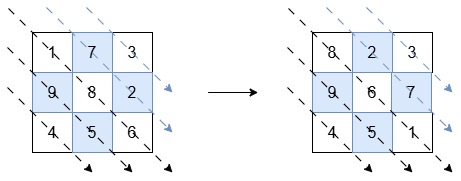
The diagonals with a black arrow (bottom-left triangle) should be sorted in non-increasing order:
[1, 8, 6]becomes[8, 6, 1].[9, 5]and[4]remain unchanged.
The diagonals with a blue arrow (top-right triangle) should be sorted in non-decreasing order:
[7, 2]becomes[2, 7].[3]remains unchanged.
Example 2:
Input: grid = [[0,1],[1,2]]
Output: [[2,1],[1,0]]
Explanation:
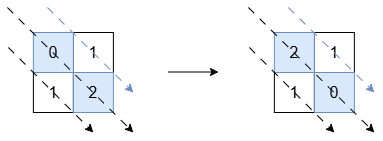
The diagonals with a black arrow must be non-increasing, so [0, 2] is changed to [2, 0]. The other diagonals are already in the correct order.
Example 3:
Input: grid = [[1]]
Output: [[1]]
Explanation:
Diagonals with exactly one element are already in order, so no changes are needed.
Constraints:
grid.length == grid[i].length == n1 <= n <= 10-105 <= grid[i][j] <= 105
 Google
Topics
Hints open one at a time
Hint 1
Use a data structure to store all values in each diagonal.
Hint 2
Sort and replace them in the matrix.
Similar problems
Sort the Matrix DiagonallyMediumLoading editor…
1class Solution:
2 def sortMatrix(self, grid: List[List[int]]) -> List[List[int]]:
3
Starter codePython 3Spaces: 4
Loading editor…
1class Solution:
2 def sortMatrix(self, grid: List[List[int]]) -> List[List[int]]:
3
Starter codePython 3Spaces: 4
Examples
Input
[[1,7,3],[9,8,2],[4,5,6]]
Input
[[0,1],[1,2]]
Input
[[1]]
Your code is saved on this device.Solution