2128. Remove All Ones With Row and Column Flips
You are given an m x n binary matrix grid.
In one operation, you can choose any row or column and flip each value in that row or column (i.e., changing all 0's to 1's, and all 1's to 0's).
Return true if it is possible to remove all 1's from grid using any number of operations or false otherwise.
Example 1:
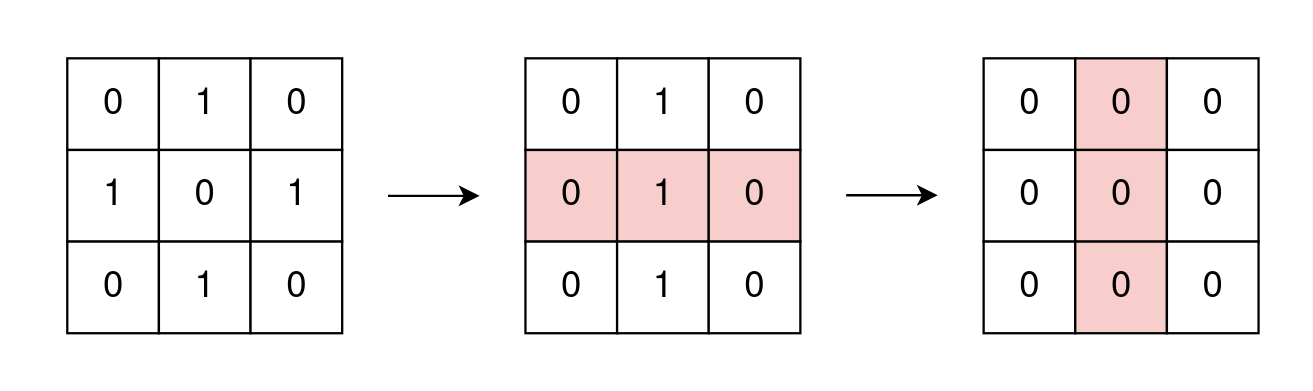
Input: grid = [[0,1,0],[1,0,1],[0,1,0]]
Output: true
Explanation: One possible way to remove all 1's from grid is to:
- Flip the middle row
- Flip the middle column
Example 2:
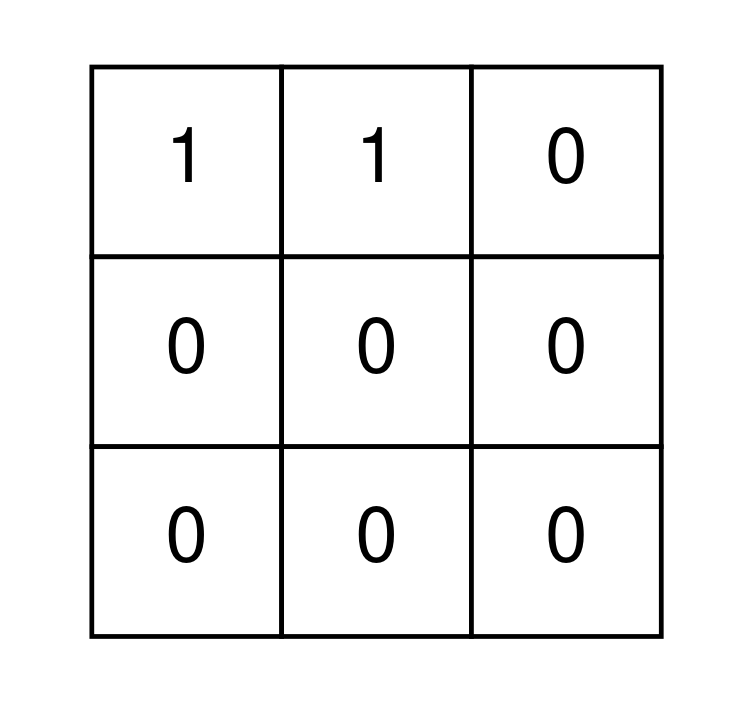
Input: grid = [[1,1,0],[0,0,0],[0,0,0]]
Output: false
Explanation: It is impossible to remove all 1's from grid.
Example 3:
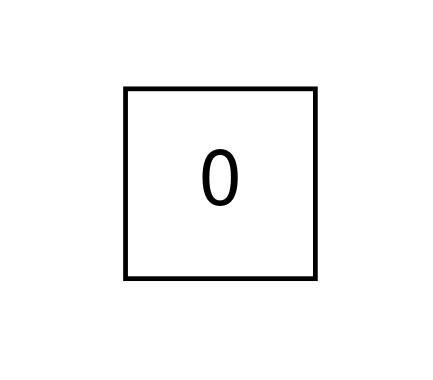
Input: grid = [[0]]
Output: true
Explanation: There are no 1's in grid.
Constraints:
m == grid.lengthn == grid[i].length1 <= m, n <= 300grid[i][j]is either0or1.
Asked at 1 company
 Google
Topics
Hints open one at a time
Hint 1
Does the order, in which you do the operations, matter?
Hint 2
No, it does not. An element will keep its original value if the number of operations done on it is even and vice versa. This also means that doing more than 1 operation on the same row or column is unproductive.
Hint 3
Try working backward, start with a matrix of all zeros and try to construct grid using operations.
Hint 4
Start with operations on columns, after doing them what do you notice about each row?
Hint 5
Each row is the exact same. If we then flip some rows, that leaves only two possible arrangements for each row: the same as the original or the opposite.
Loading editor…
1class Solution:
2 def solve(self):
3 pass
4
Starter codePython 3Spaces: 4
Loading editor…
1class Solution:
2 def solve(self):
3 pass
4
Starter codePython 3Spaces: 4
Examples
Input
[[0,1,0],[1,0,1],[0,1,0]]
Input
[[1,1,0],[0,0,0],[0,0,0]]
Input
[[0]]
Your code is saved on this device.Solution