1136. Parallel Courses
You are given an integer n, which indicates that there are n courses labeled from 1 to n. You are also given an array relations where relations[i] = [prevCoursei, nextCoursei], representing a prerequisite relationship between course prevCoursei and course nextCoursei: course prevCoursei has to be taken before course nextCoursei.
In one semester, you can take any number of courses as long as you have taken all the prerequisites in the previous semester for the courses you are taking.
Return the minimum number of semesters needed to take all courses. If there is no way to take all the courses, return -1.
Example 1:
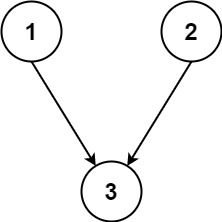
Input: n = 3, relations = [[1,3],[2,3]]
Output: 2
Explanation: The figure above represents the given graph.
In the first semester, you can take courses 1 and 2.
In the second semester, you can take course 3.
Example 2:
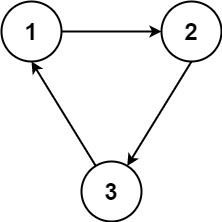
Input: n = 3, relations = [[1,2],[2,3],[3,1]]
Output: -1
Explanation: No course can be studied because they are prerequisites of each other.
Constraints:
1 <= n <= 50001 <= relations.length <= 5000relations[i].length == 21 <= prevCoursei, nextCoursei <= nprevCoursei != nextCoursei- All the pairs
[prevCoursei, nextCoursei]are unique.
 Google
Topics
Hints open one at a time
Hint 1
Try to think of it as a graph problem. It will be impossible to study all the courses if the graph had a cycle.
Hint 2
The graph is a directed acyclic graph (DAG). The answer is the longes path in this DAG.
Hint 3
You can use DP to find the longest path in the DAG.
Loading editor…
1class Solution:
2 def solve(self):
3 pass
4
Starter codePython 3Spaces: 4
Loading editor…
1class Solution:
2 def solve(self):
3 pass
4
Starter codePython 3Spaces: 4
Examples
Input
3
[[1,3],[2,3]]
Input
3
[[1,2],[2,3],[3,1]]
Your code is saved on this device.Solution