2033. Minimum Operations to Make a Uni-Value Grid
You are given a 2D integer grid of size m x n and an integer x. In one operation, you can add x to or subtract x from any element in the grid.
A uni-value grid is a grid where all the elements of it are equal.
Return the minimum number of operations to make the grid uni-value. If it is not possible, return -1.
Example 1:
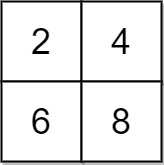
Input: grid = [[2,4],[6,8]], x = 2
Output: 4
Explanation: We can make every element equal to 4 by doing the following:
- Add x to 2 once.
- Subtract x from 6 once.
- Subtract x from 8 twice.
A total of 4 operations were used.
Example 2:
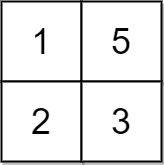
Input: grid = [[1,5],[2,3]], x = 1
Output: 5
Explanation: We can make every element equal to 3.
Example 3:
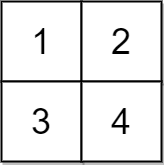
Input: grid = [[1,2],[3,4]], x = 2
Output: -1
Explanation: It is impossible to make every element equal.
Constraints:
m == grid.lengthn == grid[i].length1 <= m, n <= 1051 <= m * n <= 1051 <= x, grid[i][j] <= 104
Asked at 5 companies
 Google
Topics
Hints open one at a time
Hint 1
Is it possible to make two integers a and b equal if they have different remainders dividing by x?
Hint 2
If it is possible, which number should you select to minimize the number of operations?
Hint 3
What if the elements are sorted?
Similar problems
Minimum Moves to Equal Array Elements IIMediumLoading editor…
1class Solution:
2 def minOperations(self, grid: List[List[int]], x: int) -> int:
3
Starter codePython 3Spaces: 4
Loading editor…
1class Solution:
2 def minOperations(self, grid: List[List[int]], x: int) -> int:
3
Starter codePython 3Spaces: 4
Examples
Input
[[2,4],[6,8]]
2
Input
[[1,5],[2,3]]
1
Input
[[1,2],[3,4]]
2
Your code is saved on this device.Solution