1289. Minimum Falling Path Sum II
Given an n x n integer matrix grid, return the minimum sum of a falling path with non-zero shifts.
A falling path with non-zero shifts is a choice of exactly one element from each row of grid such that no two elements chosen in adjacent rows are in the same column.
Example 1:
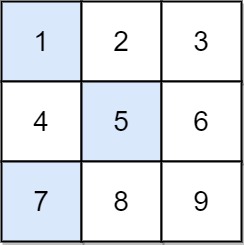
Input: grid = [[1,2,3],[4,5,6],[7,8,9]]
Output: 13
Explanation:
The possible falling paths are:
[1,5,9], [1,5,7], [1,6,7], [1,6,8],
[2,4,8], [2,4,9], [2,6,7], [2,6,8],
[3,4,8], [3,4,9], [3,5,7], [3,5,9]
The falling path with the smallest sum is [1,5,7], so the answer is 13.
Example 2:
Input: grid = [[7]]
Output: 7
Constraints:
n == grid.length == grid[i].length1 <= n <= 200-99 <= grid[i][j] <= 99
 Google
Topics
Hints open one at a time
Hint 1
Use dynamic programming.
Hint 2
Let dp[i][j] be the answer for the first i rows such that column j is chosen from row i.
Hint 3
Use the concept of cumulative array to optimize the complexity of the solution.
Similar problems
Minimum Falling Path SumMediumLoading editor…
1class Solution:
2 def minFallingPathSum(self, grid: List[List[int]]) -> int:
3
Starter codePython 3Spaces: 4
Loading editor…
1class Solution:
2 def minFallingPathSum(self, grid: List[List[int]]) -> int:
3
Starter codePython 3Spaces: 4
Examples
Input
[[1,2,3],[4,5,6],[7,8,9]]
Input
[[7]]
Your code is saved on this device.Solution