2218. Maximum Value of K Coins From Piles
There are n piles of coins on a table. Each pile consists of a positive number of coins of assorted denominations.
In one move, you can choose any coin on top of any pile, remove it, and add it to your wallet.
Given a list piles, where piles[i] is a list of integers denoting the composition of the ith pile from top to bottom, and a positive integer k, return the maximum total value of coins you can have in your wallet if you choose exactly k coins optimally.
Example 1:
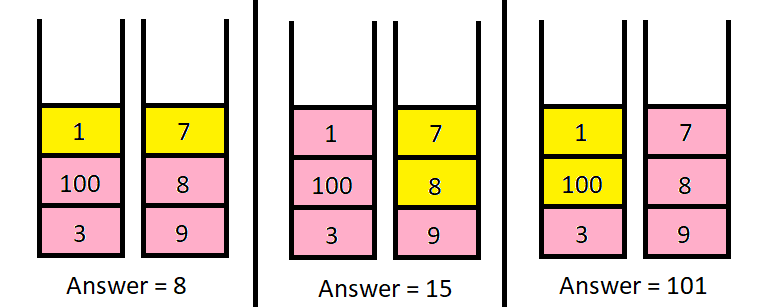
Input: piles = [[1,100,3],[7,8,9]], k = 2
Output: 101
Explanation:
The above diagram shows the different ways we can choose k coins.
The maximum total we can obtain is 101.
Example 2:
Input: piles = [[100],[100],[100],[100],[100],[100],[1,1,1,1,1,1,700]], k = 7
Output: 706
Explanation:
The maximum total can be obtained if we choose all coins from the last pile.
Constraints:
n == piles.length1 <= n <= 10001 <= piles[i][j] <= 1051 <= k <= sum(piles[i].length) <= 2000
Asked at 1 company
 Google
Topics
Hints open one at a time
Hint 1
For each pile i, what will be the total value of coins we can collect if we choose the first j coins?
Hint 2
How can we use dynamic programming to combine the results from different piles to find the most optimal answer?
Loading editor…
1class Solution:
2 def maxValueOfCoins(self, piles: List[List[int]], k: int) -> int:
3
Starter codePython 3Spaces: 4
Loading editor…
1class Solution:
2 def maxValueOfCoins(self, piles: List[List[int]], k: int) -> int:
3
Starter codePython 3Spaces: 4
Examples
Input
[[1,100,3],[7,8,9]]
2
Input
[[100],[100],[100],[100],[100],[100],[1,1,1,1,1,1,700]]
7
Your code is saved on this device.Solution