3933. Largest Local Values in a Matrix II
You are given an n x m integer matrix matrix containing non-negative integers.
A non-zero cell (row, col) checks the cells near it as follows:
- Let
x = matrix[row][col]. - Consider every cell within
xrows andxcolumns of(row, col). - Ignore cells that are outside the matrix.
- Ignore the cells where both the row distance and column distance are exactly
x.
The cell (row, col) is a local maximum if it is non-zero and no considered cell has a value greater than x.
Return an integer denoting the number of local maximums in matrix.
Example 1:
Input: matrix = [[0,0,0,0,0,0,0],[0,0,0,0,0,0,0],[0,0,0,0,0,0,0],[0,0,0,2,0,0,0],[0,0,0,0,0,0,0],[0,0,0,0,0,0,0],[0,0,0,0,0,0,0]]
Output: 1
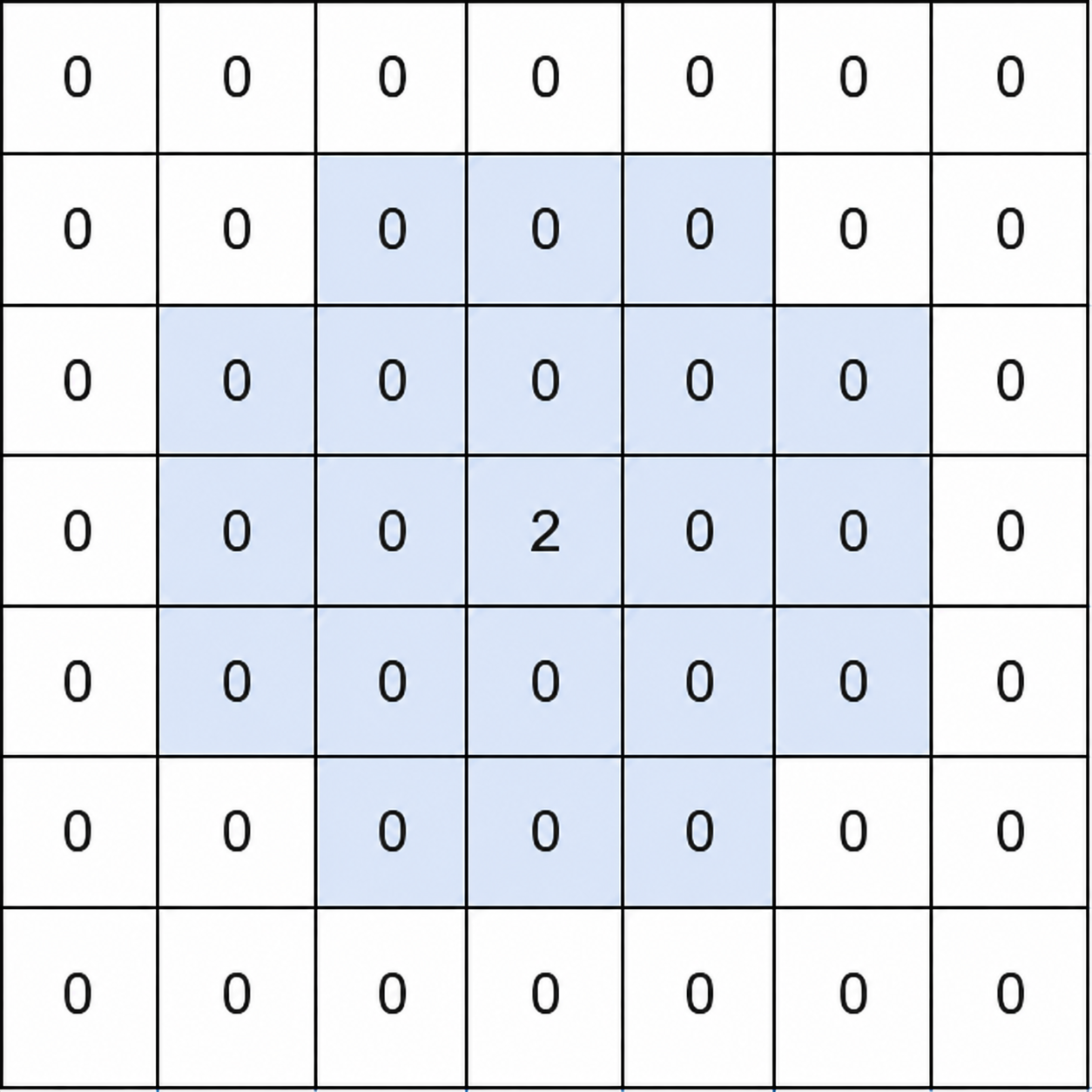
Explanation:
- For the non-zero cell
(3, 3),x = matrix[3][3] = 2. - The highlighted cells are the considered cells within
xrows andxcolumns of(3, 3). - The four cells with both row and column distances equal to
x = 2are ignored. - No considered cell has a value greater than 2, so
(3, 3)is a local maximum. - There are no other non-zero cells, so the answer is 1.
Example 2:
Input: matrix = [[1,2],[3,4]]
Output: 1
Explanation:
Only the cell with value 4 is a local maximum. Every other non-zero cell considers a cell with a greater value.
Example 3:
Input: matrix = [[1,0,1],[0,1,0],[1,0,1]]
Output: 5
Explanation:
- For a cell with value 1, the considered cells are the cell itself and its 4-directionally adjacent cells that are inside the matrix.
- Each of the five cells with value 1 only considers cells with values 0 or 1, so all five of them are local maximums.
Example 4:
Input: matrix = [[1,1],[1,1]]
Output: 4
Explanation:
All cells have the same value. Therefore, no cell considers another cell with a greater value, so all 4 cells are local maximums.
Constraints:
1 <= n == matrix.length <= 2001 <= m == matrix[i].length <= 2000 <= matrix[i][j] <= 200
Loading editor...
[[0,0,0,0,0,0,0],[0,0,0,0,0,0,0],[0,0,0,0,0,0,0],[0,0,0,2,0,0,0],[0,0,0,0,0,0,0],[0,0,0,0,0,0,0],[0,0,0,0,0,0,0]]