3902. Zigzag Level Sum of Binary Tree
You are given the root of a binary tree.
Traverse the tree level by level using a zigzag pattern:
- At odd-numbered levels (1-indexed), traverse nodes from left to right.
- At even-numbered levels, traverse nodes from right to left.
While traversing a level in the specified direction, process nodes in order and stop immediately before the first node that violates the condition:
- At odd levels: the node does not have a left child.
- At even levels: the node does not have a right child.
Only the nodes processed before this stopping condition contribute to the level sum.
Return an integer array ans where ans[i] is the sum of the node values that are processed at level i + 1.
Example 1:
Input: root = [5,2,8,1,null,9,6]
Output: [5,8,0]
Explanation:
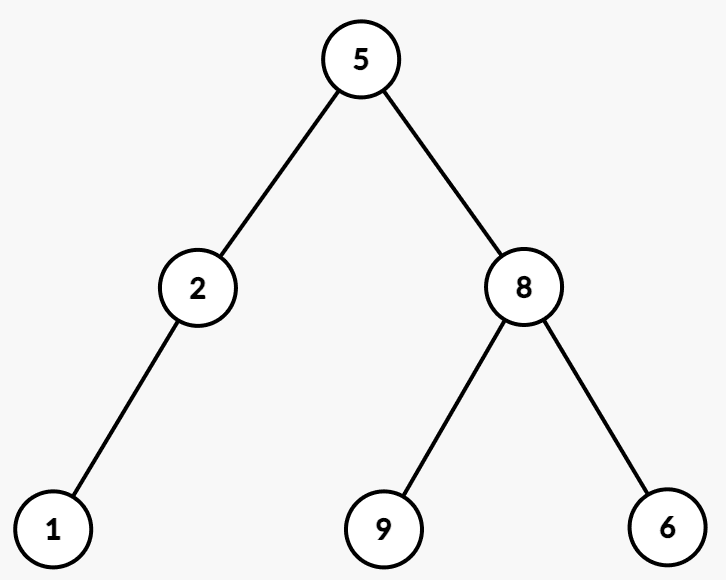
- At level 1, nodes are processed left to right. Node 5 is included, thus
ans[0] = 5. - At level 2, nodes are processed right to left. Node 8 is included, but node 2 lacks a right child, so processing stops, thus
ans[1] = 8. - At level 3, nodes are processed left to right. The first node 1 lacks a left child, so no nodes are included, and
ans[2] = 0. - Thus,
ans = [5, 8, 0].
Example 2:
Input: root = [1,2,3,4,5,null,7]
Output: [1,5,0]
Explanation:
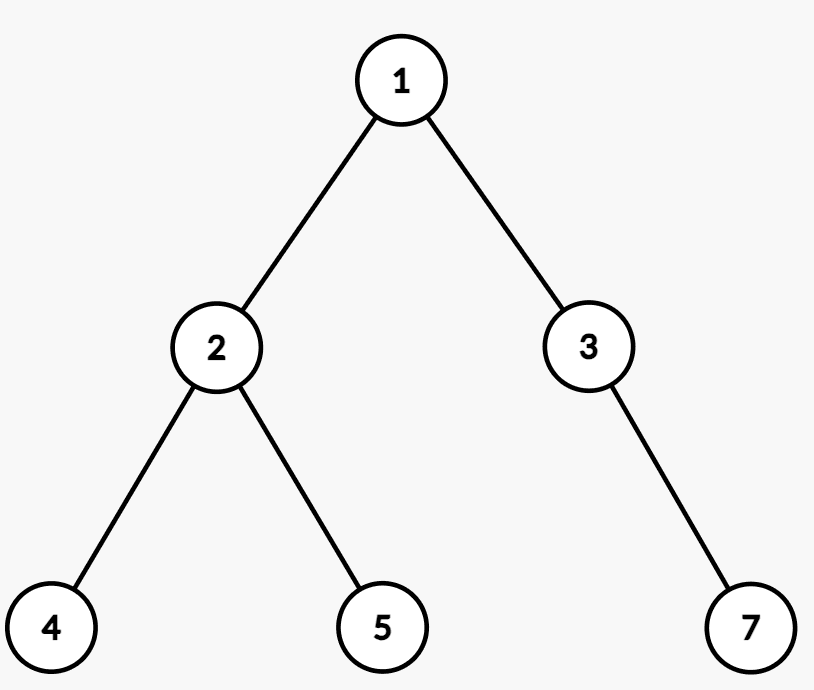
- At level 1, nodes are processed left to right. Node 1 is included, thus
ans[0] = 1. - At level 2, nodes are processed right to left. Nodes 3 and 2 are included since both have right children, thus
ans[1] = 3 + 2 = 5. - At level 3, nodes are processed left to right. The first node 4 lacks a left child, so no nodes are included, and
ans[2] = 0. - Thus,
ans = [1, 5, 0].
Constraints:
- The number of nodes in the tree is in the range
[1, 105]. -105 <= Node.val <= 105
Loading editor…
1class Solution:
2 def solve(self):
3 pass
4
Starter codePython 3Spaces: 4
Loading editor…
1class Solution:
2 def solve(self):
3 pass
4
Starter codePython 3Spaces: 4
Examples
No sample inputs for this problem yet. The examples in the statement show the format.
Your code is saved on this device.Solution