3949. Subtree Inversion Sum II
You are given an undirected tree rooted at node 0, with n nodes numbered from 0 to n - 1. The tree is represented by a 2D integer array edges of length n - 1, where edges[i] = [ui, vi] indicates an edge between nodes ui and vi.
You are also given an integer array nums of length n, where nums[i] represents the value at node i, and an integer k.
You may perform inversion operations on a subset of nodes subject to the following rules:
-
Subtree Inversion Operation:
-
When you invert a node, every value in the subtree rooted at that node is multiplied by -1.
-
-
Distance Constraint on Inversions:
-
You may only invert a node if it is “sufficiently far” from any other inverted node.
-
If you invert two nodes
aandb, the distance (the number of edges on the unique path between them) must be at leastk.
-
Return the maximum possible sum of the tree’s node values after applying inversion operations.
Example 1:
Input: edges = [[0,1],[0,2],[0,3],[1,4],[1,5]], nums = [1,0,-10,3,4,5], k = 2
Output: 23
Explanation:
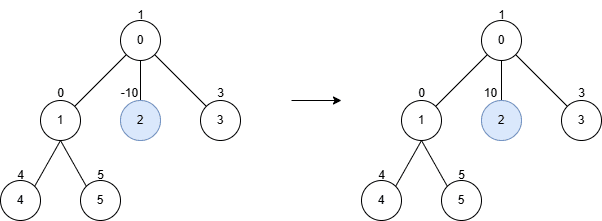
After inverting the subtree rooted at node 2, the maximum sum becomes 1 + 0 + 10 + 3 + 4 + 5 = 23.
Example 2:
Input: edges = [[0,1],[1,2]], nums = [5,-10,-10], k = 1
Output: 25
Explanation:
After inverting the subtree rooted at node 1, the maximum sum becomes 5 + 10 + 10 = 25.
Example 3:
Input: edges = [[0,1],[0,2]], nums = [1,-5,-6], k = 2
Output: 12
Explanation:
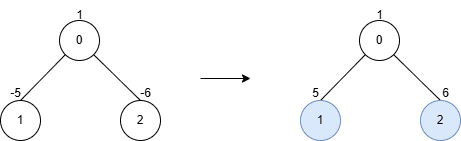
- After inverting the subtrees rooted at nodes 1 and 2,
nums = [1, 5, 6]. - This is valid because nodes 1 and 2 are two edges apart (
1 → 0and0 → 2), which is at leastk. - The maximum sum is
1 + 5 + 6 = 12.
Example 4:
Input: edges = [[0,1],[0,2]], nums = [1,-5,-6], k = 3
Output: 10
Explanation:
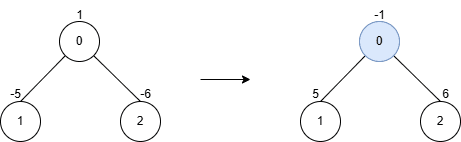
- After inverting the subtree rooted at nodes 0,
nums = [-1, 5, 6]. - The maximum sum is
(-1) + 5 + 6 = 10. - Note that we cannot invert nodes 1 and 2 because their distance is
2 < k = 3.
Constraints:
nums.length == nedges.length == n - 12 <= n <= 5 * 104edges[i].length == 20 <= edges[i][0], edges[i][1] < n-4 * 104 <= nums[i] <= 4 * 1041 <= k <= 50- It is guaranteed that
edgesforms a tree.
No sample inputs for this problem yet. The examples in the statement show the format.