3996. Even Number of Knight Moves
You are given two integer arrays start and target, where each array is of the form [x, y] representing a cell on a standard 8 x 8 chessboard.
Return true if a knight can move from start to target in an even number of moves. Otherwise, return false.
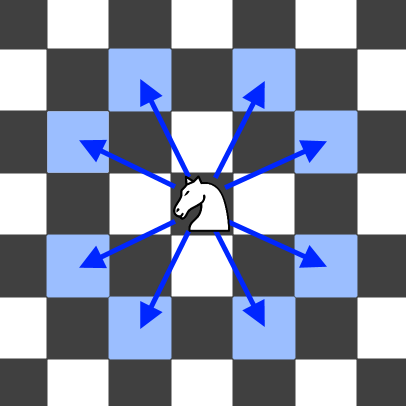
Note: A valid knight move consists of moving two squares in one direction and one square perpendicular to it. The figure below illustrates all eight possible moves from a cell.
Example 1:
Input: start = [1,1], target = [2,2]
Output: true
Explanation:
One possible sequence of moves is (1, 1) -> (3, 2) -> (2, 4) -> (4, 3) -> (2, 2).
The knight reaches the target in 4 moves, which is even. Thus, the answer is true.
Example 2:
Input: start = [4,5], target = [6,6]
Output: false
Explanation:
It is impossible to reach target = [6, 6] from start = [4, 5] in an even number of moves. Thus, the answer is false.
Constraints:
start.length == target.length == 20 <= start[i], target[i] <= 7
Topics
Hints open one at a time
Hint 1
1a (Chessboard Coloring). Color the chessboard like a standard chessboard using the parity of x + y.
Hint 2
1b (Chessboard Coloring). Every knight move changes the color of the current cell. Therefore, after an even number of moves, the knight must be on a cell of the same color as the starting cell.
Hint 3
1c (Chessboard Coloring). Since every cell is reachable from every other cell on an 8 x 8 chessboard, return whether (start[0] + start[1]) % 2 == (target[0] + target[1]) % 2.
Hint 4
2a (BFS). Treat each of the 64 cells as a node and connect two cells if a knight can move between them.
Hint 5
2b (BFS). Run BFS while tracking both the current cell and the parity of the number of moves used.
Hint 6
2c (BFS). Return true if target is reachable with even parity.
[1,1]
[2,2]
[4,5]
[6,6]