3988. Create Grid With Exactly K Paths I
You are given three integers m, n, and k.
Construct any m x n grid consisting only of the characters '.' and '#', where:
'.'represents a free cell.'#'represents an obstacle cell.
A valid path is a sequence of free cells that:
- Starts at the top-left cell
(0, 0). - Ends at the bottom-right cell
(m - 1, n - 1). - Moves only:
- Right, from
(i, j)to(i, j + 1), or - Down, from
(i, j)to(i + 1, j).
- Right, from
Return any grid such that there are exactly k valid paths from the top-left cell to the bottom-right cell. If no such grid exists, return an empty array.
Example 1:
Input: m = 2, n = 3, k = 2
Output: ["...","#.."]
Explanation:
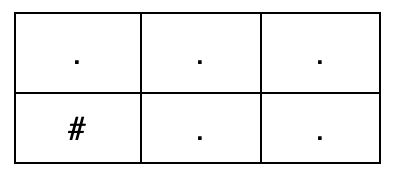
There are exactly k = 2 valid paths from (0, 0) to (1, 2):
(0, 0) → (0, 1) → (0, 2) → (1, 2)(0, 0) → (0, 1) → (1, 1) → (1, 2)
Example 2:
Input: m = 3, n = 3, k = 4
Output: ["..#","...","#.."]
Explanation:
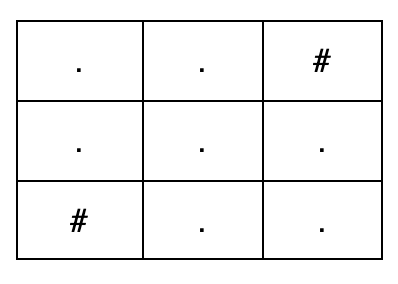
There are exactly k = 4 valid paths from (0, 0) to (2, 2):
(0, 0) → (0, 1) → (1, 1) → (1, 2) → (2, 2)(0, 0) → (0, 1) → (1, 1) → (2, 1) → (2, 2)(0, 0) → (1, 0) → (1, 1) → (1, 2) → (2, 2)(0, 0) → (1, 0) → (1, 1) → (2, 1) → (2, 2)
Example 3:
Input: m = 1, n = 4, k = 2
Output: []
Explanation:
No grid exists with exactly k = 2 valid paths for a 1 x 4 grid, so the answer is an empty array.
Constraints:
1 <= m, n <= 101 <= k <= 4
Topics
Hints open one at a time
Hint 1
If m == 1 or n == 1, the only possible positive number of valid paths is 1.
Hint 2
For m, n > 1, construct a small grid pattern with exactly k paths for each k from 1 to 4.
Hint 3
For k = 2, use a 2 x 2 open block. It has exactly two paths: right then down, or down then right.
Hint 4
For k = 3, use a 2 x 3 open block, or a 3 x 2 open block. An empty 2 x 3 grid has exactly three paths.
Hint 5
For k = 4, use either a fully open 2 x 4 block, a fully open 4 x 2 block, or a 3 x 3 block with the top-right and bottom-left cells blocked.
Hint 6
After building the small block, connect its bottom-right cell to (m - 1, n - 1) using a single corridor, and fill all other cells with obstacles. If the required block cannot fit in either orientation, return an empty array.
2
3
2
3
3
4
1
4
2