4077. Minimize Inversions in a Prefix Tree
You are given an array words of n unique strings containing only lowercase English letters from 'a' to 'j'. You are also given an integer array target containing each index from 0 to n - 1 exactly once.
Build a prefix tree from words:
- The root represents the empty string
"". - Each other node represents a different non-empty prefix of a word. The parent of a node is the prefix obtained by removing its last character.
- The node representing the complete word
words[i]is marked with indexi. A marked node may also have children.
You may choose the order of the children of each node independently. You cannot change which node is a child's parent.
Traverse the tree starting at the root. When visiting a node, first record its index if it is marked. Then visit its children in the chosen order, completing the traversal of each child before moving to the next. This is a pre-order traversal.
The recorded indices form an array traversal of length n. Let pos[i] be the position of index i in target.
An inversion is a pair of positions (a, b) such that 0 <= a < b < n and pos[traversal[a]] > pos[traversal[b]].
Return the minimum possible number of inversions over all choices of child orderings.
Example 1:
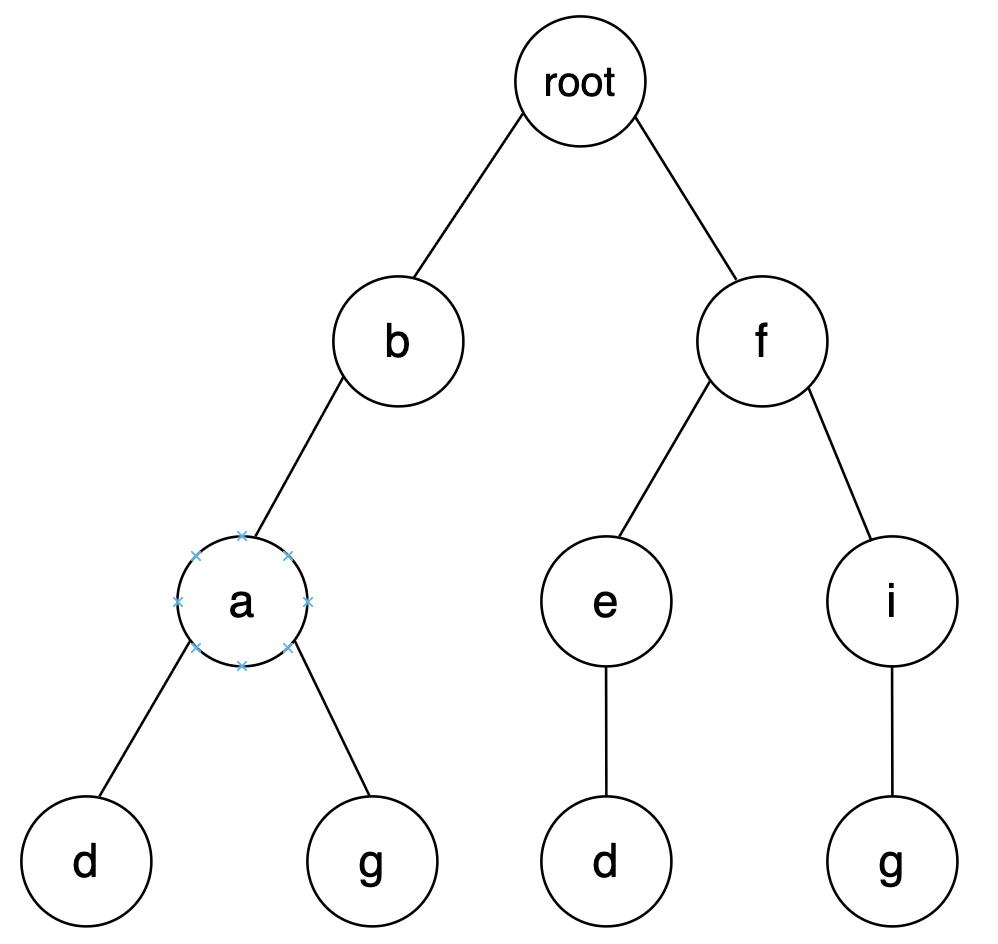
Input: words = ["bad","bag","fig","fed"], target = [3,1,0,2]
Output: 2
Explanation:
Visit the root's "f" child before its "b" child. Within the "f" branch, visit "fed" before "fig". Within the "b" branch, visit "bag" before "bad".
This produces traversal = [3,2,1,0]:
| Traversal position | Word index | Word | Position in target |
|---|---|---|---|
| 0 | 3 | "fed" |
0 |
| 1 | 2 | "fig" |
3 |
| 2 | 1 | "bag" |
1 |
| 3 | 0 | "bad" |
2 |
The positions in target are [0,3,1,2]. The inversions are the pairs of traversal positions (1,2) and (1,3), since 3 > 1 and 3 > 2.
No child ordering produces fewer than 2 inversions.
Example 2:
Input: words = ["ab","ac","ba","bc"], target = [0,3,1,2]
Output: 1
Explanation:
Visit the root's "a" child before its "b" child. Within these branches, visit "ab" before "ac", and "bc" before "ba".
This produces traversal = [0,1,3,2]:
| Traversal position | Word index | Word | Position in target |
|---|---|---|---|
| 0 | 0 | "ab" |
0 |
| 1 | 1 | "ac" |
2 |
| 2 | 3 | "bc" |
1 |
| 3 | 2 | "ba" |
3 |
The positions in target are [0,2,1,3]. The only inversion is the pair of traversal positions (1,2), since 2 > 1.
No child ordering produces zero inversions.
Constraints:
1 <= n == words.length <= 1041 <= words[i].length <= 20words[i]contains only lowercase English letters from'a'to'j'- All
words[i]are unique 0 <= target[i] <= n - 1targetis a permutation of integers from 0 ton - 1
["bad","bag","fig","fed"]
[3,1,0,2]